DDP Talks To
"The Devil Ties My Tongue" by Amy Seiwert performed for the SKETCH Series, 2013. Photo by David DeSilva. Courtesy of Amy Seiwert's Imagery
October 16th: Tapestries Choreographic Program, October 20th: 2026 Dance Film Commission, October 20th: SPLIT BILL Series, October 22nd: Perform Europe Open Call, October 30th: Kennesaw State University Choreographic Residency, November 1st: Howard Fellowship, November 5th: CHOP SHOP: Bodies of Work, December 1st: Culture Forward Grant - The Svane Family Foundation Deadline 3, December 1st: Harkness Foundation for Dance Program/Project Grant, December 2nd: NYS Choreographers Initiative (NYSCI), December 31st: National Dance Project Presentation Grants - New England Foundation for the Arts, December 31st: National Dance Project Travel Fund, December 31st: New England Presenter Travel Fund, December 31st: Kit Modus In-person Choreographic Residency
×

"The Devil Ties My Tongue" by Amy Seiwert performed for the SKETCH Series, 2013. Photo by David DeSilva. Courtesy of Amy Seiwert's Imagery
By Michael Cooper
5 September 2019
The Dallas Opera canceled its big-ticket March 2020 gala concert with the opera star Plácido Domingo on Thursday amid new accusations that he had sexually harassed multiple women.
The Dallas company, where the Spanish-born Mr. Domingo made his United States debut in 1961 on his way to opera stardom, became the third major American institution to cut ties with him over the recent allegations, joining the Philadelphia Orchestra and the San Francisco Opera. Mr. Domingo is still scheduled to sing later this month at the Metropolitan Opera in New York; the Met has said it was awaiting the outcome of an investigation by the Los Angeles Opera into the allegations against Mr. Domingo, the company’s general director.
Dallas pulled the plug on its gala after The Associated Press, which reported the first round of mostly anonymous allegations against Mr. Domingo last month, published a new report Thursday in which a singer named Angela Turner Wilson went on the record and accused Mr. Domingo of reaching into her robe and grabbing her bare breast during a makeup call when they were appearing together in Massenet’s “Le Cid” at the Washington Opera in 1999.
Read the full article in The New York Times.
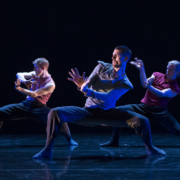
FLOCK, a company founded by a male/female duo of former Hubbard Street Dance Chicago dancers is evidence of the support and mentorship that HSDC artistic director Glenn Edgerton provides his dancers. Co-founder Alice Klock, in particular, has a history of support in her choreographic endeavors from the company. Klock was the winner of Hubbard Street’s International Commissioning Project and was the company’s choreographic fellow in 2017. Co-founder Florian Lochner, too, was a fellow in 2017.
The two branched out together to form Flock that same year, and the company’s mission is rooted in the equity and inclusion that is difficult to find in larger dance companies.
“It is a priority of ours to create work in which the roles of everyone in the creation are balanced. We are very conscious of the tendency in dance to fall back on traditional gender roles. We construct all of our pieces to avoid these and to open up to new definitions of what it means to be vulnerable or strong. When teaching we find a way to invest in everyone in the room equally as we believe everyone has something individual and powerful to share. ”
Watch the Dance Magazine feature of the pair and their company, FLOCK, below:
Learn more about FLOCK on its website.

This is the second entry to my diary, and as my week in residency at the Sydney Opera House as part of the Emerging Female Classical Choreographer Initiative has come to a close, I am looking back on this incredible week reflecting and absorbing all the new information, people and experiences. I was given advice that I cannot wait to put into action starting out in my career, and as a young choreographer.
Walking up to the incredible Sydney Opera House on the first day and every day after that, I was feeling very special and thinking about all the great artists and people who have walked into the same house. Once I arrived at the stage door on the first day, I was introduced to Rehearsal Room 77. A beautiful, cosy studio which I would call my creative space for the week. I was able to focus solely on being a choreographer and putting myself into that mindset, which time hasn’t allowed in the past because of being a dancer taking my main focus during my 5 professional years.
I was able to work with 4 pre-professional dancers and 1 understudy who are all students of Tanya Pearson Coaching Academy. It was interesting for me to work with students and have the freedom to give them my ideas and I admire how much they threw themselves into my piece. It was also a challenge for me to be able to communicate and adapt my ideas in a way which their bodies understood.
Read more at https://www.danceaustralia.com.au/news/amelia-s-diary-2#XfeI6E46MeHif21f.99
By Wendy Taucher
4 September 2019
As director of the World Choreography Institute, I am often asked if choreography can be taught. My answer is an emphatic “maybe.”
Nature versus nurture in choreography presents the argument: Can creativity be taught, or is it a gift? The jury is out, with research and vociferous opinions coming down on both sides. I tend to come down on the side of “it’s a gift,” and that inspired artistic creation cannot be taught. Structural technique, and methods of analysis, rehearsal, and experimentation can — and should be — taught. Especially in choreography.
Why especially? Because it’s not done. Not enough, anyway. The reasons for this are multifaceted, complex, and exist as much by habit as by economics and logistics. The lack of choreographic training exists in all dance genres, each with its own particular issues, but all tending to put choreographers in the position of producing too many works in too little time.
Creating choreography poses more problems than making new work in any other art form. Painters need canvas, paints, and brushes. Playwrights need paper and pen, or the contemporary equivalent. Composers need knowledge of notation, an instrument, or the ability to hear music in their head. They can work alone. Choreographers need bodies and space. Space is expensive, and dancers should be. And that’s prohibitive, often causing choreographers to premiere works before they are fully cooked.
Read the full article on My Times.
Cincinnati Ballet is opening its season with innovative premieres in their Kaplan New Works Series. Year-after-year the evening program brings new works to the stage before excited audiences. Including women in this tradition is a trend for artistic director Victoria Morgan; this year her Kaplan roster is no exception.
The press release for the program detailed the lineup: “The Kaplan New Works Series brings raw, powerful contemporary ballet to the Aronoff Center for the Arts for 11 performances September 12-22. This year’s New Works includes six world premieres.Celebrate the start of the Season with a mix of innovative dance interpreted by some of today’s most talented choreographers, including a trio of female powerhouses. Heather Britt, Cincinnati native and choreographer-extraordinaire, celebrates her 10th anniversary choreographing for Cincinnati Ballet with her emotional piece, When I Still Needed You. She’s joined by internationally renowned choreographer Andrea Schermoly with Swivet, and Sarah Van Patten, longtime San Francisco Ballet principal dancer, presents her new work, Skylight.”
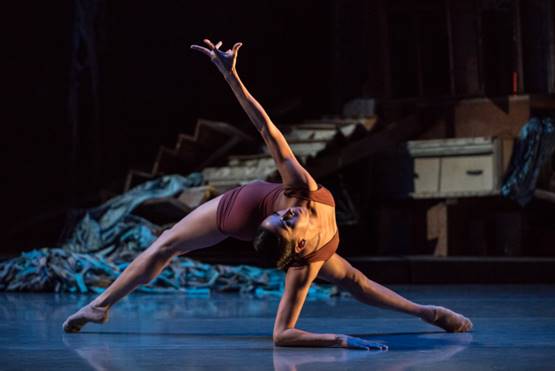
Cincinnati Ballet’s 2018 Kaplan performance included new works from Jennifer Archibald, Taylor Carrasco, Mia Michaels, David Morse, and Myles Thatcher. Thanks to this and other performances including female choreographers, the company was on DDP’s top 10 list for the 2018-2019 season (read the July report here). The announced works for its upcoming season’s programming placed Cincinnati Ballet again on this list for the 2019-2020 season. A stunning 56% of the company’s works announced so far for this season will be choreographed by women, and Cincinnati Ballet is one of the only five companies leading the way with the most inclusive programming in both seasons.
The DDP team looks forward to coverage of this innovative programming in the press and celebrates Morgan and Cincinnati Ballet for another season of empowering (and commissioning) women.
About Cincinnati Ballet
Since 1963, Cincinnati Ballet has been the cornerstone professional ballet company of the region, presenting a bold and adventurous array of classical, full-length ballets and contemporary works. Under the artistic direction of Victoria Morgan, Cincinnati Ballet has become a creative force within the larger dance community, commissioning world premiere works and exploring unique collaborations. With a mission to inspire hope and joy in our community and beyond through the power and passion of dance, Cincinnati Ballet reaches beyond the stage in programs that allow every person in the region to be part of the continued evolution of dance through exhilarating performances, extensive education outreach programs and top-level professional ballet training at Cincinnati Ballet Otto M. Budig Academy.
Purchase tickets and learn more here.
The Illinois Department of Labor is gearing up to help business owners with the new ‘no salary history’ law, which takes effect Sept. 29. The measure prohibits employers from asking applicants what they made in a previous job.
Under the measure, asking about salary history as a way to determine pay could result in a fine.
Michael Kleinik, director of the Illinois Department of Labor, said he’s taking the necessary steps to educate employers and help them avoid those penalties.
“Most companies would have to redo their application process. Probably most applications ask what the past salary is, so they have to get away from that.”
In case of a violation, the Illinois Department of Labor would investigate.
Kleinik said there is additional information on their website. A hotline is available at 312-793-6797 to help answer questions. Kleinek said he’s also working on preparing workshops and other outreach events across the state.
Listen to the story here.
By Stephanie Bunbury
30 August 2019
It is no surprise to read that Yang Liping found it impossible to toe the line as part of the China Central Ethnic Song and Dance Ensemble. Yang, 60, whose dramatic dance works draw from the folkloric dances she learned as a small child growing up in rustic Yunnan province, is famous in China as the Peacock Princess. This may not be entirely to do with her masterly evocation of this spectacular bird in her first popular success, Spirit of the Peacock, which made her name in 1986.
Yang cuts a dramatic figure in fitted satin, heavy jewellery and nails like a 19th-century mandarin’s. She tells me, with a bit of a giggle, that she has been growing those extraordinary claws since 1979, ostensibly to give authentic performances of the Long-Nailed Dance. Most dancers use glittery fake fingernails, readily available online in boxes of 10: I checked. How does she get the lid off a jar? You get used to it, she tells the tour manager who is our linguistic go-between. China in 1979 was still the land of the Mao suit. Amid all that denim, Yang Liping must have looked like an explosion of silk, varnish and theatricality.
Two years ago, Yang came to Australia with Under Siege, a spectacular choreographic retelling of the Chu-Han Contention of 200 BC – an epic battle for supremacy between the Chu and Han armies that is one of China’s most important ‘‘origin’’ stories. It included kung fu, tai chi, hip-hop, Chinese opera and, of course, a spectacular set.
Read the full story in The Brisbane Times.
By Briana Rice
27 August 2019
Days after “Good Morning America” host Lara Spencer apologized for “insensitive” comments mocking Prince George for taking a ballet class, Cincinnati Ballet is working to support male dancers.
The controversy began last week when Spencer brought up Prince George’s back-to-school plans in a clip published Thursday.
“In addition to the usual first or second-grade things like math, science and history, the future king of England will be putting down the Play-Doh to take on religious studies, computer programming, poetry and ballet, among other things,” Spencer said.
The clip then cuts to images of the 6-year-old, but laughter can be heard from the “GMA” set.
“Prince William says George absolutely loves ballet. I have news for you, Prince William: We’ll see how long that lasts,” Spencer added with a chuckle.
Read the full article in The Cincinnati Enquirer.
.
By Liz Frazier
Women’s Equality Day celebrates the passage of the 19th Amendment, giving women the right to vote. The progress we’ve made over the past century is clear; more women are running for office, we make up nearly half of the work force and are more likely than our male counterparts to attend college and earn professional degrees.
So how is it then, after almost 100 years of progress towards equality, are women still only making 81% of what men are making? Weekly earnings dating back to 1979 show a gender pay gap, when women earned 62% of what men earned. In 2018, women’s median earnings were 81% of men’s. While the gap has narrowed, progress has virtually stalled for the past 13 years, hovering around 80-83% . (US Bureau of Labor Statistics).
To find a solution to this problem, we first need to understand the root. The pay gap has been attributed to multiple factors, such as: women are more likely to leave the workforce to care for their families or having to do with education. A study conducted by The Ascent, a division of The Motley Fool, took a deeper look into some of these commonly given reasons for the gender pay disparity.
Read the full article on Forbes.com.
By Valerie-Jean Miller
Celebrating the centennial of the Nineteenth Amendment granting women the right to vote; assembled and produced by Deborah Brockus, artistic director of the annual Los Angeles Dance Festival.
Deborah Brockus has assembled another TKO of a presentation. This time at the aesthetically invigorating and lovely renovated Ford Theatre; originally entitled, prophetically first named, The PILGRIMAGE Theatre. It was an enlivening evening from start to finish. Ms. Brockus is a hands-on participant, besides organizing, directing, choreographing and publicizing and cheerleading all involved, she was there to greet the theatre goers and anyone coming to support and witness this celebration. Take note of her tenacity and perseverance.
Ms. Brockus has been labeled “the single most important person in Southland dance,” an “impresario”, “the mother superior of LA dance” and “tireless” by the Los Angeles Times for her involvement in establishing the local dance scene as a producer, choreographer and teacher.
Read the full article on BWW.