DDP Talks To
"The Devil Ties My Tongue" by Amy Seiwert performed for the SKETCH Series, 2013. Photo by David DeSilva. Courtesy of Amy Seiwert's Imagery
March 26th: New & Experimental Works (NEW) Program, March 31st: SIA Foundation Grants, April 1st: Palm Desert Choreography Festival, April 1st: New England States Touring (NEST 1 and 2), April 17th: World Arts West (WAW) Cultural Dance Catalyst Fund, September 14th: New England Dance Fund, October 13th: Community Arts Grant - Zellerbach Family Foundation, December 1st: Culture Forward Grant - The Svane Family Foundation, December 31st: National Dance Project Presentation Grants - New England Foundation for the Arts, December 31st: National Dance Project Travel Fund, December 31st: New England Presenter Travel Fund
×
"The Devil Ties My Tongue" by Amy Seiwert performed for the SKETCH Series, 2013. Photo by David DeSilva. Courtesy of Amy Seiwert's Imagery

BY SALLIE KRAWCHECK
31 July 2019
A woman I know once said something to me that I think about every day: “I’m tired of supporting businesses and institutions that haven’t supported me. I no longer want to have my money managed at a company at which I wouldn’t want my daughter to work.”
That hit me, hard. And I couldn’t agree more.
So what does that look like — in an industry in which 86% of financial advisors are men? What are the questions we should be asking so that we can dig deeper, find out if our values align, see whether an advisor will truly support us?
Here are six of them.
First things first: What’s the gender breakdown of your team of financial advisors? What about the senior leadership team? And how has that changed over the past 5 years?
Most will lead with their “commitment to diversity.” But the proof is in the executive team, so to speak. If they say they’re all about diversity, but the people who lead the firm or look out for their clients’ best interests all look the same, then their “commitment” doesn’t hold much water, does it?
Read the full article on Ellevest.
By Kelly Apter
29 July 2019
In 2014, when Scottish Ballet premiered Helen Pickett’s one-act version of The Crucible, I wrote in my review that ‘the world needs more Helen Picketts’. Five years later, with the imbalance between male and female choreographers on the world stage still problematic, I stand by that statement. But happily, in 2019 what we do have is more of Pickett herself – literally.
That 45-minute, one-act adaptation of Arthur Miller’s play about the Salem witch trials has been razed to the ground and rebuilt – emerging as a full-length narrative ballet that will premiere at this year’s Edinburgh International Festival. Written in 1953, Miller’s tale of 17th-century paranoia and oppression has benefitted not only from Pickett’s punchy and intelligent choreography, but the assured directorial wisdom of James Bonas.
Each brings something unique and special – Pickett trained at San Francisco Ballet, spent 11 years working with William Forsythe at Ballet Frankfurt, then moved to New York to hone her own creative style. Bonas bagged a First from Oxford University then studied at the Royal Academy of Dramatic Art, before carving out a career as an actor, then theatre and opera director.
‘I’d never worked on a ballet before,’ concedes Bonas straight off the bat, ‘I didn’t even call myself a dramaturg, because I didn’t know what that meant. But the principal thing I could bring to The Crucible, is how to tell a story with people’s bodies – and a lot of the work I’ve done in both theatre and opera is coming from that place anyway.
Read the full article on The List.

How often should couples talk about money? Plus: What’s the stupidest financial advice you’ve heard lately? Sallie answers the real questions in the latest Money in 60 Seconds.
Missing the pointe: The Dance Data Project looked at the 2018–2019 seasons of the 50 largest ballet companies in the US. Turns out that 81% of ballets produced last season were choreographed by men. OK then.
Megan Thee Stallion is trademarking #HotGirlSummer. She should, and here’s why.
“The endgame is clear: Bank of America wants the women out of power at Alex and Ani.” That’s from a $1.2 billion lawsuit by the women-led company, which is also claiming that Bank of America’s actions “have sent a once-thriving American success story into a death spiral.”
Read the full newsletter or subscribe here.
23 May 2019
Larissa Archer has been asked to perform for free so many times she’s lost count.
Despite her years of training, impressive resume and credibility as the founder of San Francisco Bellydance Theater, she often finds herself turning down invitations to dance for a few wrinkled dollar bills.
As Archer explains it, event producers “can’t cut corners on how much beer costs. They can’t cut corners on the rental of the venue.” But many can, and often do, skimp on the take-home pay of the talent that attracts showgoers in the first place.
And it’s not just small clubs. As KQED first reported in March, despite reaching a valuation of $1 trillion last year, tech giant Apple doesn’t pay the artists performing in its stores, compensating them with low-end merchandise such as AirPods and AppleTVs instead.
Following our report, we heard from graphic designers, musicians, muralists and comedians who say they’re frequently asked to work for “exposure” by companies large and small, sharing tales of missing payments, false promises of paid work and full-time jobs disguised as unpaid internships.
Read the full article on KQED Arts.
By Mireia Borrell-Porta, Joan Costa-Font, Julia Philipp
14 December 2018
We study the effect of parenting daughters on attitudes towards gender norms in the UK; specifically, attitudes towards the traditional male breadwinner norm in which it is the husband’s role to work and the wife’s to stay at home. We find robust evidence that rearing daughters decreases fathers’ likelihood to hold traditional attitudes. This result is driven by fathers of school-aged daughters, for whom the effects are robust to the inclusion of individual fixed effects. Our estimates suggest that fathers’ probability to support traditional gender norms declines by approximately 3%age points (8%) when parenting primary school-aged daughters and by 4%age points (11%) when parenting secondary school-aged daughters. The effect on mothers’ attitudes is generally not statistically significant. These findings are consistent with exposure and identity theories. We conclude that gender norm attitudes are not stable throughout the life-course and can significantly be shaped by adulthood experiences.
In recent decades, concerns about gender equality have been increasingly prominent in both the political and the social spheres, prompting governments to embark on the task of alleviating gender differences inside and outside the labour market. Nevertheless, progress towards achieving gender equality appears to have gradually slowed down (Eagly and Wood, 2012; Gender Equality Index, 2017). Against this background, a growing body of research has established the importance of traditional gender norms in explaining the persistence of gender inequalities in wages (Burda et al., 2007), in labour force participation (Fernández et al., 2004; Fortin, 2005; Fernández and Fogli, 2009; Farre and Vella, 2013; Johnston et al. 2014), and in the division of domestic work (DeMaris and Longmore, 1996; Greenstein, 1996, and see Davis and Greenstein 2009 for a review). However, there is limited evidence on how susceptible to change such norms are. This paper addresses this question.
Read the rest of the introduction and article in the Oxford Economic Papers.
By Ruthie Fierberg
25 July 2019
Dance Lab New York and The Joyce Foundation have partnered to support female choreographers of color through the establishment of a developmental lab, allowing for these artists to create new work in classical, neoclassical, and/or contemporary ballet dance.
From October 14–November 10, choreographers Preeti Vasudevan, Micaela Taylor, Amy Hall Garner, and Margarita Armas will explore new works, culminating in a showcase at Guggenheim’s Works & Process.
Each choreographer will have access to rehearsal space at the Joyce Artist Residency Center, eight paid professional dancers, a rehearsal director, as well as a stipend and financial and logistical operations support over the course of 30 working hours.
“As the conversation is shifting within the field of ballet to the lack of female choreographers, and more specifically the lack of opportunities for female dance makers of color, The Joyce has entered into a unique collaboration with DLNY to help address gender and racial inequity through shared resources”, said Joyce Executive Director Linda Shelton in a statement. “This collaboration prioritizes research and development with no expectation of a final ‘product’ as an essential step forward. True to The Joyce’s and DLNY’s shared values, this pilot partnership embraces the concepts of risk, experimentation, and trial and error.”
Read the full article on Playbill.
By Anna J. Park
24 July 2019
Korean National Ballet’s principal dancer Shin Seung-won is preparing for an upcoming performance this weekend. This time, though, she won’t be taking center stage; she is choreographer and director of her seven-minute creative ballet piece, titled “Go your own way.”
During a recent interview with The Korea Times, the principal ballerina said she feels a different sort of happiness from being a choreographer instead of a dancer.
“When I see my choreographed piece on stage, it feels very rewarding; when I’m dancing as a ballerina, I become delightful and joyous. They are two different feelings, yet both are somewhat linked, and both precious. In other words, choreography is like raising my own children, and dancing ballet on stage makes me feel alive and immensely happy,” the ballerina said.
Shin is one of the eight Korean National Ballet members who will be showcasing their own modern ballet works, choreographed by themselves, during “KNB Movement Series 5,” set for this Saturday and Sunday afternoon at Seoul Arts Center’s CJ Towol Theater.
In 2015, the national ballet jump-started the “KNB Movement Series,” an annual showcase presenting newly-choreographed modern ballet pieces by the ballet company members. Ballet dancers who participate in the annual performance not only need to choreograph every movement, but also direct all elements of the set, from lighting and costumes to music.
Principal Dancer Lee Young-cheol has been participating in this annual show every year, with his own creative ballet works. This year, he presents “Season: Spring,” a ballet inspired by the image of a long trail covered with fallen cherry blossom petals. Other works include soloist Song Jung-bin’s “Amadeus Concerto,” Demi-Soloist Kim Myung-kyu’s “3 Tables” and Corps de Ballet Kang Dong-hui’s “Bad Guy.”
Read the full article in The Korea Times.
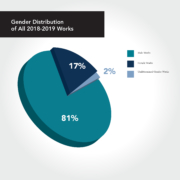
The following is a report on the gender distribution of repertoire within the Top 50 domestic companies’ 2018-2019 seasons. The data is separated into three subsections: Gender Distribution in Seasonal Repertoire, World Premieres, and Comparison of 2018-2019 Seasons to 2019-2020 Seasons. DDP cites sources and expresses limitations at the end of the report.
21 July 2019
HOLLYWOOD, Calif. — Driven by the #MeToo movement and the recent wave of attention on sexual harassment in the entertainment industry, the union representing actors and other artists announced Sunday that it is working with groups and professionals to develop a set of standards for the depiction of on- screen intimacy.
“Our goal is to normalize and promote the use of intimacy coordinators within our industry,” said Gabrielle Carteris, president of the Screen Actors Guild-American Federation of Television and Radio Artists. “Intimacy coordinators provide an important safety net for our members doing hyper-exposed work. At a time when the industry still needs to make great changes, our initiative will ensure the safety and security of SAG-AFTRA members while they work and respects the boundaries of actors.”
SAG-AFTRA will work with Alicia Rodis, the associate director and co- founder of Intimacy Directors International, and other “trained providers to standardize, codify and implement guidelines for on-set intimacy coordinators,” the union said in a statement released Sunday. The guidelines will “seek to establish new, relevant policies for nudity and simulated sex; define the duties and standards for intimacy coordinators on productions; and specify acceptable training, vetting and qualifications of intimacy coordinators.”
Read the full story on Fox 5 San Diego.
By Hilarie M. Sheets
22 March 2017
When Thomas P. Campbell steps down as director of the Metropolitan Museum of Art on June 30, the top job at the biggest art museum in the United States will be up for grabs. A woman faces long odds of landing that job, to judge from a study just released from the Association of Art Museum Directors.
“The Ongoing Gender Gap in Art Museum Directorships” shows that just one of the nation’s 13 largest museums is run by a woman. The report is a follow-up to a 2014 study, the first to analyze salary data collected from the association’s 200-plus membership from the vantage point of gender.
Women today are nearing equity over all, leading 48 percent of art museums, up from 43 percent three years ago. A gender gap persists, however, at the largest museums — those with budgets of $15 million and higher, where just 30 percent have female directors. And as the budgets grow, the ranks of women thin, with just three women heading the 20 largest-budget institutions in the association.
“The first step in addressing inequality is acknowledging it,” said Lisa Phillips, director of the New Museum in New York, who initiated the 2014 study and consulted on the new report. “Hard data makes it plain and clear.”
Read the full article in The New York Times.