DDP Talks To
"The Devil Ties My Tongue" by Amy Seiwert performed for the SKETCH Series, 2013. Photo by David DeSilva. Courtesy of Amy Seiwert's Imagery
October 16th: Tapestries Choreographic Program, October 20th: 2026 Dance Film Commission, October 20th: SPLIT BILL Series, October 22nd: Perform Europe Open Call, October 30th: Kennesaw State University Choreographic Residency, November 1st: Howard Fellowship, November 5th: CHOP SHOP: Bodies of Work, December 1st: Culture Forward Grant - The Svane Family Foundation Deadline 3, December 1st: Harkness Foundation for Dance Program/Project Grant, December 2nd: NYS Choreographers Initiative (NYSCI), December 31st: National Dance Project Presentation Grants - New England Foundation for the Arts, December 31st: National Dance Project Travel Fund, December 31st: New England Presenter Travel Fund, December 31st: Kit Modus In-person Choreographic Residency
×

"The Devil Ties My Tongue" by Amy Seiwert performed for the SKETCH Series, 2013. Photo by David DeSilva. Courtesy of Amy Seiwert's Imagery
The Opening Night of Boston Ballet’s 2019 ChoreograpHER initiative showing will be next Wednesday, October 23 at the Boston Ballet Headquarters.
DDP Founder Liza Yntema will be in Boston to celebrate this special program dedicated to showcasing and championing the work of emerging female choreographers (for the second year in a row).
In early 2019, DDP featured Boston Ballet principal dancer and inaugural ChoreograpHER artist Lia Cirio on our blog. This would be Lia’s first attempt at creating a work. Her piece, Sta(i)r(e)s, was well-received by the Boston audience, and its creation signified a leader among dancers stepping into a role often encouraged only for men at other companies.
To The Globe, artistic director Mikko Nissinen said, “’The best way to help is to provide an opportunity.” The initial showings last year were sold out with, for the first time ever, six women choreographers featured in a performance.
Learn more about ChoreograpHER here.

DDP Founder and President Liza Yntema is a Lead Sponsor of ChoreograpHER.

By Abigail Miller
19 October 2019
Just two days before her piece “Don’t Explain” was to be performed at The Ashley Bouder Project’s fifth anniversary show, assistant professor of dance Catherine Meredith was in the midst of the only practice she would get with the ballet dancers performing it.
Associate professor of dance Jeffrey Rockland recommended Meredith’s work to Ballet in The City, the company that planned the event, when it reached out to Kent State for a piece from a local choreographer.
Meredith said she had initially sent a different piece called “Aftermath” to Bouder’s team for consideration, but it was turned down because it was too modern.
“Jessica (a representative from Ballet in The City) said, ‘Look, I love the piece but it’s too modern,’” Meredith said. “I said, ‘I have something else.’ I sent it and she’s like, ‘I love it. Let me send it to Ashley.’ Ashley saw it and said, ‘Yeah, let’s put it on the program.’”
The piece is set to Nina Simone’s version of the Billie Holiday song “Don’t Explain” and tells the story of a continuously unfaithful partner. Meredith suspected Simone chose to cover the song due to the similarities between it and her own life.
“Basically it’s a woman saying, ‘Don’t explain, because if you explain it that makes it real and then I have to do something about it,’” Meredith said. “Nina Simone later recorded it and in a parallel life she was married to a man, a police detective who was physically abusive. I think the song also resonated with her as to, ‘here I am, in love with this person who is hurtful.’”
…
According to a recent report done by the non-profit group Dance Data Project, 81 percent of the pieces performed during the 2018-2019 season by the top 50 ballet companies in the United States were choreographed by men.
Read the full article on kentwired.com

Beginning on November 1, Nashville audiences can enjoy Annabelle Lopez Ochoa’s acclaimed A Streetcar Named Desire . The work includes stage direction by Nancy Meckler, as well as costumes and set designs by Niki Turner. The female powerhouses behind the piece make it a notable program during a season in which women remain the minority within U.S. ballet company seasons.
DDP Founder and President Liza Yntema will visit Nashville Ballet in November to learn more about the company and its efforts to include and prioritize women in this and future seasons.
Watch the company’s promotional video for the production below!
Learn more about Nashville Ballet and the upcoming season here.

According to the National Ballet of Cuba, Alicia Alonso, the prima ballerina assoluta and founder of what would become the National Ballet of Cuba, passed away on October 17th, 2019 at the age of 98.
For The New York Times, Jack Anderson wrote, “A ballerina of unusual range and power, she continued to dance into her 70s despite chronic vision problems.”
Celebrated both in her home country of Cuba and around the world, Alonso was a choreographer and leader as well as a famed dancer, and will be remembered long after her time on this Earth.
Read more about Alonso in The New York Times.
By Brian Seibert
17 October 2019
At American Ballet Theater’s fall gala on Wednesday, along with premieres by Jessica Lang and Twyla Tharp, there was much talk of women. The honoree, Lisa Lutoff-Perlo, the president and chief executive of Celebrity Cruises, drew a parallel between the fight against gender imbalances in her industry and in ballet. Just as she congratulated herself for hiring the first and so far only female captain, so she praised Ballet Theater for its Women’s Movement initiative supporting female choreographers.
The stark maritime statistics were new to me, but not the ballet numbers. For several years now, people in the ballet world have not just been talking about the longstanding gender imbalance in choreography; they’ve been changing it. Efforts like Ballet Theater’s have been giving female choreographers more chances to create work and get it seen, more chances to do what male choreographers have always been allowed to do: sometimes make hits, sometimes make duds.
Read the full article in The New York Times.

17 October 2019
This weekend’s Louisville Ballet production — a three-bill performance called “Serenade + at High + Velocity” — will feature a dance designed by the company’s newest addition and first-ever female resident choreographer, Andrea Schermoly.
Before 2018, the Louisville Ballet company did not have designated positions for resident choreographers but did hire female choreographers for dozens of shows. So, while Schermoly is not the first woman to ever choreograph a show at Louisville Ballet, she is the first official resident choreographer, a yearslong contracted position with the company that includes consistent commissions and collaboration.
It’s a high-profile gig in a male-dominated industry.
Schermoly’s choreographed dance, “at High” — accompanied by a live orchestral performance of Gustav Mahler’s Fourth Symphony — is not her first work with the Louisville Ballet. She choreographed the company’s performance of Martha Graham’s “Appalachian Spring” in February and has been involved in previous years of the Choreographer’s Showcase.
Before her dancing career was ended by an injury and she began choreographing in full force, Schermoly danced professionally for the Boston Ballet Company and the Netherlands Dance Theater, and trained at the National School of the Arts in Johannesburg, where she grew up.
Read the full article on USA Today’s Courier Journal.
17 October 2019
Practice is over and Boston Celtics assistant coach Kara Lawson is still working.
She stands under the basket rebounding and giving feedback to rookie guard Carsen Edwards as he shoots from different spots on the court. After swishing his final three attempts he jogs over to her.
“Thanks, coach,” Edwards says before exchanging a high-five with Lawson.
Welcome to the new-look NBA, in which women’s footprints are directly impacting every aspect of the game — from broadcasting booths, to officiating, coaching on the sidelines, front-office executives to ownership.
Lawson is one of a record 11 women serving as assistant coaches in the NBA this season. While former WNBA star Swin Cash and Sue Bird are working in NBA front offices.
“It’s not a fad,” said Basketball Hall of Famer Nancy Lieberman. “It’s opportunities going to very accomplished women who have given their life to the game.”
While it may not be a fad, it is a recent trend.
Read the full article in The Chicago Sun Times.
By Alison Starling/ABC7 News
11 October 2019
WASHINGTON (ABC7) — The Washington Ballet Theatre officially opens its new season in October. At the helm of the company is a woman who is known as one of the premier dancers in America, Julie Kent.
The Washington Ballet is not performing Swan Lake until April, but rehearsals are well underway.
In command of each move and magical step is Julie Kent, the artistic director for the Washington Ballet. But for nearly 30 years, she was captivating audiences with the American Ballet Theatre in New York. She was its longest-serving ballerina and principal dancer for more than 20 of those years.
Kent tells ABC7, “I think it was the greatest gift and greatest privilege to spend your life doing something that you love.”
Watch the video here.
We know some of our followers don’t have the time to read our full reports right away – that’s why DDP maintains a document of our most interesting findings. You can read the 2019 Highlights now for all the facts. Click the link below to download.
By Jane Howard
12 April 2019
In 2009, director Neil Armfield stood on the stage at Sydney’s Belvoir St Theatre and announced, for his swansong season as artistic director of the company he co-founded, a season of shows almost exclusively written and directed by men.
It was a moment that prompted considerable scrutiny of industry-wide gender disparity.
In that year, at the eight best-funded Australian theatre companies — members of the Major Performing Arts Group (MPAG) — just 24 per cent of plays were written by women, and 24 per cent were directed by women. A staggering 86 per cent of productions had at least one man as writer or director.
But in the decade since, something remarkable has happened. The balance has shifted.
In 2019, women will make up 47 per cent of playwrights and 58 per cent of directors at MPAG theatre companies. And, for the first time ever, more of these productions will have at least one woman in a lead creative role (67 per cent) than at least one man (60 per cent).
Read more in ABC Arts.

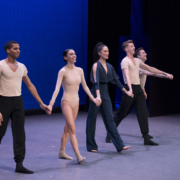 Photo by Liza Voll. Courtesy of Boston Ballet.