DDP Talks To
"The Devil Ties My Tongue" by Amy Seiwert performed for the SKETCH Series, 2013. Photo by David DeSilva. Courtesy of Amy Seiwert's Imagery
October 30th: Kennesaw State University Choreographic Residency, November 1st: Howard Fellowship, November 5th: CHOP SHOP: Bodies of Work, November 23rd: Camille A. Brown and Dancers Mentorship Program, December 1st: Culture Forward Grant - The Svane Family Foundation Deadline 3, December 1st: Harkness Foundation for Dance Program/Project Grant, December 2nd: NYS Choreographers Initiative (NYSCI), December 31st: National Dance Project Presentation Grants - New England Foundation for the Arts, December 31st: National Dance Project Travel Fund, December 31st: New England Presenter Travel Fund, December 31st: Kit Modus In-person Choreographic Residency, December 31st: Gross Family Prize: Charles and Joan Gross Family Foundation, December 31st: Foundation for Contemporary Arts Emergency Grants, December 31st: Fertile Ground 2026-2027 Season
×
"The Devil Ties My Tongue" by Amy Seiwert performed for the SKETCH Series, 2013. Photo by David DeSilva. Courtesy of Amy Seiwert's Imagery
Announcements about the Dance Data Project™ including new research, upcoming initiatives, additions to the team, and other exciting news.
Dance Data Project® (DDP) today published its ninth study. For this collaboration with the Center for Equity, Gender, and Leadership (EGAL) at UC Berkeley’s Haas School of Business, MBA Candidate Patrick Crocker joined DDP in an examination of gender equity in the 50 largest U.S. dance venues. The “Dance Venue Leadership and Programing Report” reveals nearly-complete gender parity at all levels of dance venue leadership. Research indicates that if a venue selects a ballet company led by a woman, the resulting work is more likely to include works choreographed by women.
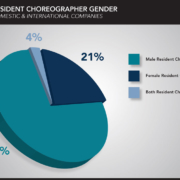
Dance Data Project® (DDP) has conducted an initial examination of resident choreographer positions globally within the ballet industry.
DDP found that among the 116 international and U.S. ballet companies studied, a significant majority have hired men as resident choreographers. The study reveals that 37 of the 116 ballet companies surveyed globally employ resident choreographers. Twenty-eight of these 37 companies have placed exclusively men in this position (76%). Read the report here.
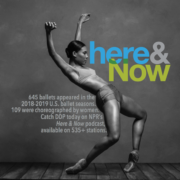
December 23, 2019 Northfield, Illinois Dance Data Project® (DDP) research was discussed in a Here & Now piece on National Public Radio (NPR) on Friday, December 20. Following reporter Sharon Basco’s initial investigation of the lack of women choreographers in ballet, published in WBUR’s The ARTery and covered in a Here & Now story in 2015, the program discussed the shifting “no girls allowed” atmosphere in the artform.
The 2012-2013 ballet season research by Amy Seiwert and Joseph Copley – in which of 290 ballets programmed by a sample of companies that season, just 25 were choreographed by women – set the stage for the story. “Major companies went year after year without staging a single ballet by a woman,” narrated Basco, “People began to take notice.” Former chief dance critic of the New York Times, Alastair Macaulay, was one of those people, Basco shared, “[Macaulay] points to an awakening in the past few years – and changes are underway, starting with several companies hiring female artistic directors.”
The notion that having more women running ballet companies may serve as a catalyst in the growing equity in ballet, has often been discussed, and has been reflected in the seasons of companies like the English National Ballet, Cincinnati Ballet, and more. Basco interviewed the artistic director of the former, Tamara Rojo, who agreed, stating, “Today it will be very, very strange for any company to announce a season where there is no female representation.”
Basco noted, however, that female representation in programming is just the tip of the iceberg. Citing DDP’s July 2019 report, she said, “This season, fewer than 20% of ballets are by female choreographers.” Furthermore, she noted, “The women commissioned for major work do so mainly as freelancers, not resident choreographers.” As the DDP team conducted research this month on global resident choreographers, indeed, not one of the “Top 10” U.S. ballet companies (ranked by budget) had a female resident choreographer in 2019. Women are rarely afforded the “luxury of an institutional home,” and, beyond this, they are often paid only a fraction of the compensation offered to male choreographers. Twenty-seven-year-old choreographer (and principal dancer at New York City Ballet) Lauren Lovette weighed in, saying, “That is the next step. It’s like, okay, thank you for giving an opportunity, now will you pay me the same?”
One of the rare “exceptions” to the glass ceiling is veteran choreographer Helen Pickett, who concluded the piece on an optimistic note, saying, “This is the ground we walk on now – that WE walk on now – and let’s keep on going forward with that.”
DDP will release more findings in January following an investigation of the role of equity in major U.S. dance venue leadership and programming, as well as the first global study of resident choreographers.
Listen to the story on WBUR’s website or below:
December 20, 2019 Northfield, Illinois Dance Data Project ® (DDP) today features in a Here & Now piece on National Public Radio (NPR). Following reporter Sharon Basco’s initial investigation of the lack of women choreographers in ballet, published on WBUR’s The ARTery and subject of a Here & Now story in 2015, the program examines multiple factors in the art form which contribute to inequity.
Basco cited Amy Seiwert and Joseph Copley’s 2012 research, which addressed the issue for the Cincinnati Enquirer, in addition to DDP’s 2019-2020 season findings in her article, “In ‘BB@home: ChoreograpHER,’ The Women of The Boston Ballet Show Ingenuity And Talent.”
Of the lack of women choreographers, Basco wrote:
When you look at ballet you enjoy the movement, the shape of the dance, the performers, and, if there is any, the music and the story. You may marvel at the dancers’ skill, strength, artistry and charisma. Chances are, you don’t immediately focus on the person who created the work. But now, for very good reasons, the ballet world is thinking about who makes its dances.
DDP is delighted to share news of NPR’s national coverage of the lack of opportunities for female leadership in classical dance. We anticipate this platform will inspire others in all aspects of ballet to take concrete steps to include more women choreographers in programming. “Systematic exclusion of women choreographers is just the tip of a culture-wide problem in the global industry of ballet. While, by most estimates, women make 80% of what is made by their male counterparts, in 2017, female artistic directors earned just 68% of the amount earned by male artistic directors. In 2016 that figure was only 62%,” said DDP Founder and President Liza Yntema. DDP will release more findings in January following an investigation of the role of equity in major U.S. dance venue leadership and programming.
Read Basco’s review of Boston Ballet’s BB@home: ChoreograpHER and discussion of women in ballet for WBUR’s The ARTery here.
Interested parties can listen to Here & Now live on the radio (find a station near you that broadcasts the program here) and online (Monday-Friday 12 p.m. to 2 p.m. EST) here. The story in question airs at 1:20 p.m. EST. Individual stories can be found following the air time at either 2:30 p.m. EST or 3:30 p.m. EST online at WBUR. Links will also be available at www.dancedataproject.com/category/press/. DDP encourages listeners to join this important conversation by leaving a comment at the end of the story.
For more information and ways to listen, visit https://www.wbur.org/hereandnow/ways-to-listen.
Please contact Isabelle Vail, ivail@dancedataproject.com, with any questions.
Edit: The story’s recording is now available here.

Read the following excerpt from The New Yorker‘s Goings On About Town, written by dance critic and writer Marina Harss. DDP gets a shoutout within her recommendation of the Guggenheim Works & Process this Sunday (a discussion of the experience of women choreographers of color in dance).
The dearth of ballets choreographed by women is a matter of record—a new group called Dance Data Project has calculated that less than twenty per cent of the ballets that premièred in 2018-19 were made by women, and works created by women of color represents a tiny fraction of that. Dance Lab New York and the Joyce Theatre Foundation have partnered to create a Choreographic Lab, designed specifically to offer opportunities to this grossly underrepresented demographic. At the Guggenheim, four choreographers who have taken part in the lab—Margarita Armas, Courtney Cochran, Amy Hall Garner, and Preeti Vasudevan—show their work and discuss the challenges of breaking out in this male-dominated field.
MARINA HARSS
See the full list of Goings On About Town in The New Yorker.
By Moira Macdonald
31 October 2019
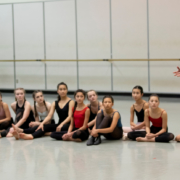
On an autumn afternoon in a cavernous Pacific Northwest Ballet studio, something brand-new was slowly beginning to take shape. Choreographer Eva Stone, whose ballet, “F O I L,” will make its world premiere as part of the “Locally Sourced” program in November, watched intently as a group of PNB’s female dancers settled into her work, memorizing it in their bodies.
“It’s almost like your hearts are beating in unison,” she said of the delicate movements of a trio. Urging the dancers to immerse themselves in each moment, Stone reminded them that the steps were actually uncomplicated. “The magnificence,” she said, “is in you.”
Just the quiet, everyday miracle of art and bodies, but there was something unusual going on that day.
Though we often think of ballet in terms of women — pointe shoes, tutus, swan queens — female choreographers are relatively rare in the ballet world, and local female choreographers at PNB are even rarer. Stone, a Seattle-based dance-maker and producer (she curates the annual dance festival, “CHOP SHOP: Bodies of Work,” and is artistic director of the Stone Dance Collective), is making her PNB debut as a choreographer. She’s one of only five women whose choreography has been seen on PNB’s mainstage in the last five seasons, along with Twyla Tharp, Crystal Pite, Jessica Lang and Robyn Mineko Williams. In that same time frame, 27 men have presented their work.
…
While ballet company rosters tend to be slightly majority-female (PNB currently has 47 dancers on its roster, 27 of whom are women), the statistics for those who create the dances tell another story. The Dance Data Project, which examined the top 50 American ballet companies, found that for the 2018-19 season, 81 percent of the works performed by those companies was choreographed by men; for 2019-20, that figure was 79 percent. PNB’s average is in the same neighborhood — over the past five seasons, 83 percent of the works on its stage have been choreographed by men.
Read the full article in The Seattle Times.
“Locally Sourced,” a Pacific Northwest Ballet program featuring three world-premiere ballets from local choreographers: “F O I L” by Eva Stone, “Love and Loss” by Donald Byrd,” and “Wash of Grey” by Miles Pertl. Nov. 8-17, McCaw Hall, 321 Mercer St., Seattle; $37-$190; 206-441-2424, pnb.org
By Sharon Basco
25 October 2019
When you look at ballet you enjoy the movement, the shape of the dance, the performers, and, if there is any, the music and the story. You may marvel at the dancers’ skill, strength, artistry and charisma. Chances are, you don’t immediately focus on the person who created the work.
But now, for very good reasons, the ballet world is thinking about who makes its dances.
Historically, it’s overwhelmingly a male domain, with most ballet companies going year after year without a single piece made by a woman. In the 2012-2013 season, U.S. ballet troupes with budgets exceeding $5 million staged some 290 ballets. Just 25 of those were choreographed by women, according to research compiled by the Cincinnati Enquirer. According to a new research organization called the Dance Data Project, men will choreograph some 79 percent of works this season.
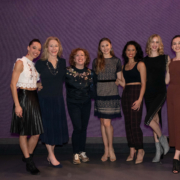
The Boston Ballet is trying to strike a more even balance. They’ve given female dancers the time and opportunity to create short ballets. This effort, called “ChoreograpHER,” presents its second season this week (it’s sold out) featuring six pieces by female company members. The venue is the small but well-appointed theater in the company’s South End headquarters.
Read the full article in The Artery.
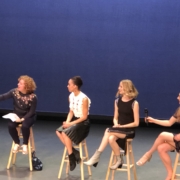
It was a delight and privilege for DDP founder & president Liza Yntema to attend a preview of Boston Ballet’s BB@home: Choreographer showing on Wednesday.
The performance on Thursday is sold out, and will present new works by Principal Dancer Lia Cirio, Soloist Chyrstyn Fentroy, Second Soloist Lauren Herfindahl, and Artists Sage Humphries, Abigail Merlis, and Joy Womack.
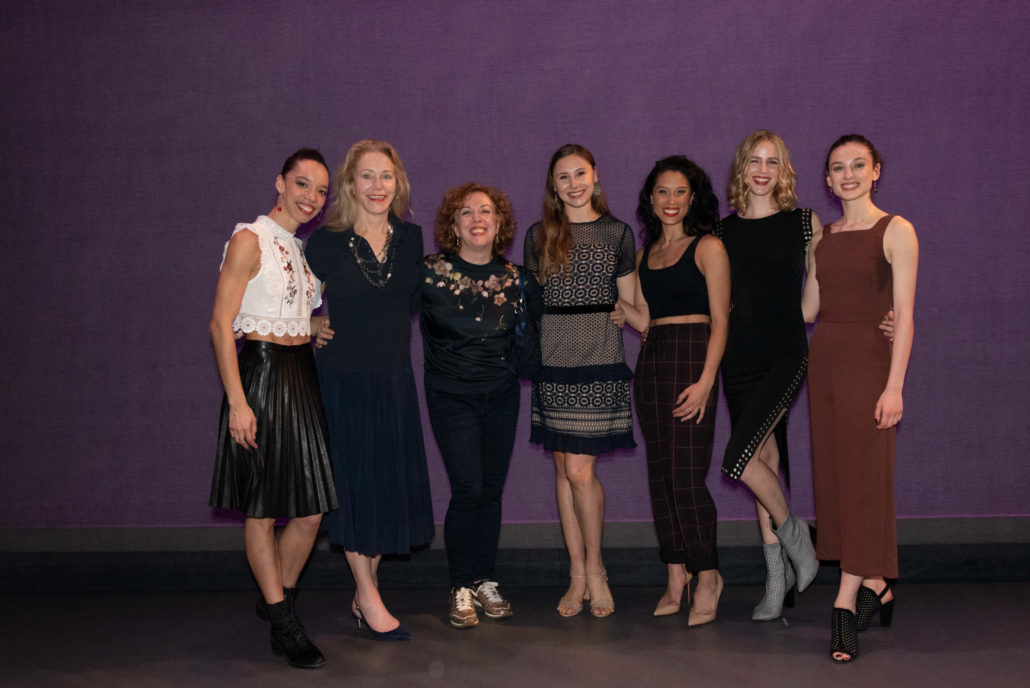
Following the preview showing, Liza was able to meet the artists and take a quick picture before her travels south to Washington, D.C. for The Washington Ballet’s NEXTsteps performance on Thursday.
We know some of our followers don’t have the time to read our full reports right away – that’s why DDP maintains a document of our most interesting findings. You can read the 2019 Highlights now for all the facts. Click the link below to download.
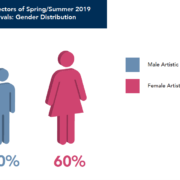
Dance Data Project® released its sixth comprehensive report today, this time examining gender equity in spring/summer dance festival leadership and programming. For the first time in a DDP study, women make up a sizable majority in the category of artistic direction. As always, sources and limitations are cited at the end of the report.