DDP Talks To
"The Devil Ties My Tongue" by Amy Seiwert performed for the SKETCH Series, 2013. Photo by David DeSilva. Courtesy of Amy Seiwert's Imagery
October 16th: Tapestries Choreographic Program, October 20th: 2026 Dance Film Commission, October 20th: SPLIT BILL Series, October 22nd: Perform Europe Open Call, October 30th: Kennesaw State University Choreographic Residency, November 1st: Howard Fellowship, November 5th: CHOP SHOP: Bodies of Work, December 1st: Culture Forward Grant - The Svane Family Foundation Deadline 3, December 1st: Harkness Foundation for Dance Program/Project Grant, December 2nd: NYS Choreographers Initiative (NYSCI), December 31st: National Dance Project Presentation Grants - New England Foundation for the Arts, December 31st: National Dance Project Travel Fund, December 31st: New England Presenter Travel Fund, December 31st: Kit Modus In-person Choreographic Residency
×

"The Devil Ties My Tongue" by Amy Seiwert performed for the SKETCH Series, 2013. Photo by David DeSilva. Courtesy of Amy Seiwert's Imagery

By Kim Brooks
8 May 2020
In our country, staying home to raise children is one of the most devastating financial decisions a woman can make. And without any sort of child care system in place, it’s often not a choice at all. All but the wealthiest mothers face what I’ve come to think of as the Cinderella paradox. Of course Cinderella can go the ball, just as soon as she’s finished her chores.
This goes a long way to explain the feminization of poverty. Jenny Brown, the author of “Birth Strike: The Hidden Fight Over Women’s Work,” writes, “Parents, particularly mothers, become poorer because they are not properly compensated for the contribution they’re making to the continuation of society by bearing and raising children.”
What exactly is the value of this contribution? The birthrate in the United States has fallen to a record low of 1.73. People who complain that other people’s children shouldn’t be their concern will still have to deal with the economic catastrophe of an aging population and a shortage of young, healthy workers. If raising these future citizens isn’t socially necessary labor, I’m not sure what is.
And yet our entire economic system hinges on the willingness of women to do this work for free. Caretakers who work outside the home are poorly paid, but those who care for their own kin, in their own homes, aren’t paid at all. They receive a wage of zero dollars and zero cents, no health insurance, no sick leave, no paid time off, no 401(k).
For a long time, I tried not to think about it. One of the ways I was able to not think about it was because I could pay other women to lighten my load. For the time being, those days are over.
Maybe that’s for the best.
Read the full article in the New York Times.
By Lauren Warnecke
6 May 2020
Each month, I preview upcoming dance events for See Chicago Dance, highlighting the productions that excite me the most. My job is to entice dance audiences to circle a date in their calendars, to make room for dance and to experience something they might otherwise not have tried.
Large venues closed in mid-March as the COVID-19 health crisis found its way to Chicago. By the end of that month, nearly everything was shut down. Many Chicagoans have more room than ever in their calendars. I write trips to the grocery store in my planner so I can feel as though I accomplished something that day. And artists necessarily pivoted, reacting to the crisis by venturing into digital forums to continue to make work.
This column is not a critic’s pick of online dance concerts, because I don’t intend to watch any.
Over the past several weeks, I talked to many dance leaders. While it’s clear that dance is struggling, it is the nature of dancers to make it work and present an air of optimism. I felt this acutely in private conversations and in an online convening gathering leaders from Chicago Dancemakers Forum, Links Hall, the Museum of Contemporary Art, High Concept Labs, the Harris Theater, Pivot Arts, and others to report on the state of their organizations. I heard nothing but certitude, even as they spoke about postponed productions, cuts in staff, vanishing grant money and cancelled galas.
Legacy organizations like the Joffrey Ballet, Giordano Dance Chicago, Hubbard Street Dance Chicago and Ensemble Espanol, each with more than 40 years of history, have weathered many storms. None quite like this. They may survive by remembering what it was like at the beginning, trimming the fat and whittling down to the core of their missions.
Then there are those who will view the crisis opportunistically. With dance universally leveled, here is a chance for smaller venues and independent artists to get ahead, since they will be able to open sooner. Here is a once in a century window of hibernation in which to reimagine the arts, and to fix that which has always ailed it: Could the pandemic serve as a springboard to abandon scarcity models once and for all? Can a diverse coalition rise to ensure a more equitable, sustainable future for the arts?
Read the article here.
By Wendy Perron
5 May 2020
Co-creator of Contact Improvisation, improviser extraordinaire, and founder and co-editor of Contact Quarterly, Nancy Stark Smith passed away on May 1. A force as a dancer and an educator, she created a network of love for improvisation on a global scale. She died in her home in Florence, MA, of ovarian cancer. Messages from all over the world registered shock, sadness and poetic memories on social media.
She cracked open gender codes in dance with one casual comment. After watching Steve Paxton’s Magnesium (1972), a dance of hurling and falling for men, she told Paxton, “If you ever work like this with women, I’d love to know about it.”
She was a buoyant yet grounded improviser. Whether springing up out of the floor or boomeranging off another person, she made the pleasure of touch visible. She had a wondrous way of talking/writing about the sensations of momentum that drew people in.
On Facebook, her friend and early CI dancer, Christie Svane, wrote, “Our beloved Nancy Stark Smith left her wild and gentle dancing, unique, glorious, fearless body on Earth and made for home. Her collaborator and companion, Mike Vargas, pianist, composer and sound artist, was by her side at home in Florence, Mass. with her beloved flower garden beginning to bloom.
Read the full article here.
By Madeline Schrock
16 April 2020
Looking for a change from all that social-media scrolling while you’re social distancing? Check out the Shut In Dance Film Fest, a newly launched opportunity for dancers are home. Helmed by Nicole Berger, Andrew Pearson and Cain DeVore, the all-remote festival is doubling as free training grounds for artists who want to boost their dance-for-camera skills.
Here’s how it works: Select one of four prompts—like camouflaging yourself in your apartment or playing with your silhouette and profile—and create a short film using your smartphone. (The Shut In team recommends using FiLMiC Pro, a $14.99 app available for Apple and Android devices.)
Submissions will be evaluated by the creative directors who came up with the prompts: Los Angeles–based dance duo WHYTEBERG, choreographer and freelancer Madison Hicks, spoken word artist City James, and Mark Dendy and Stephen Donovan of dendy/donovan projects. They will choose footage from the submitted videos to each create a final dance film cut together by professional editors.
Read the full article from Dance Magazine here.

By Rachel Caldwell
29 April 2020
Soon after taking the reins of San Francisco–based Smuin Contemporary Ballet in 2007, artistic director Celia Fushille realized that if the company was going to stay afloat, it would need its own building. With rental rates for commercial spaces in the Bay Area skyrocketing over the past decade, continuing to lease grew unsustainable for the 26-year-old nonprofit troupe. “We tried to lease, but couldn’t compete with tech companies,” says Fushille. “In 2009, I said to my board that we needed a permanent home for Smuin. I didn’t see how we were going to survive otherwise.”
Thanks to a $10 million capital campaign and a fortuitous collaboration with a dancer-turned-real-estate broker, that vision has now become a reality with the purchase of a 7,200-square-foot warehouse space in Potrero Hill, San Francisco.
After years of being nomads, Smuin could no longer justify the ballooning rental rates in the area. A typical commercial lease for an industrial or warehouse space in San Francisco runs about $60 to $72 per square foot compared to a national average of $26. Tack on the taxes, insurance and maintenance fees, and renting gets high pretty fast.
Read the full article here.
By Sallie Krawcheck
28 April 2020
Can I fret for a minute?
I’m worried sick about the financial health of women coming out of this pandemic.
Women went into the downturn with fewer financial resources than men. The “gender wealth gap” is just 32 cents to a man’s dollar, much worse — and frankly, much more meaningful — than the more commonly cited 82-cents-to-the-dollar gender pay gap.
It may be early days, but women are losing jobs at a greater rate than men during this pandemic, even though women (particularly women of color) make up a greater percentage of essential workers who are on the front lines.
For those women who are able to work from home, there is some indication that women’s productivity is being hit harder than men’s: In academia, men are submitting 50% more scholarly papers than before quarantine, while women are submitting fewer. Looks like traditional gender roles may be following families into quarantine.
I’m also worried about women entrepreneurs.
Before the pandemic, one could make the argument that women business owners weren’t making enough progress on starting companies and getting them funded, but we were making progress nonetheless. Women-owned businesses have been on the rise for years. Last year saw more $1 billion “unicorn” start-ups led by women than ever before. There was a mini-boom in women entrepreneurs on magazine covers.
Read the full article on Ellevest.
DDP has released Global Fellowships, Competitions, and Initiatives Guide 2020. The Guide is a comprehensive list of international opportunities for choreographers to develop, workshop, and present dance works.
By Kelly Smith
25 April 2020
The resignation of a renowned Twin Cities dance leader following sexual misconduct allegations has raised a call for greater protections and dialogue in the industry.
At TU Dance, a prestigious dance company in St. Paul, co-founder Uri Sands resigned at the end of December, nearly two months before the company reached an undisclosed settlement with a former dancer. Five former dancers told the Star Tribune they experienced years of misconduct from Sands. But through an attorney, Sands, 46, who started the St. Paul company with his wife, denied any misconduct, saying he “believed that he had consensual, adult relationships with those individuals.”
Now, some dancers are pushing the community to confront consent issues in the wake of the MeToo movement — like other industries, from yoga to gymnastics, have done.
“Definitely [what happened at TU Dance] has repercussions,” said Sally Rousse, a veteran ballet dancer, choreographer and co-founder of James Sewell Ballet in Minneapolis. “We need to talk about it. We could lead the work in the country in exemplifying appropriate touch, appropriate behavior. … Dancers are held up to [a] highly sexualized, objectified place. It would be great if we could reclaim the appropriate behavior.”
Read the full article in the StarTribune.
By Amy Santiago
23 April 2020
A Frida Kahlo-inspired production entitled “Broken Wings” premiered online Wednesday, April 22, according to a recent article.
Colombian-Belgian artist Annabelle Lopez Ochoa choreographed the production performed by the English National Ballet (ENB). She is also behind the choreography for Frida, a production for the Dutch National Ballet in 2002.
As the world confronts the challenges brought by the COVID-19 outbreak, theaters are forced to close, but some have brought their productions online. This marks the first time the full-length recordings of the company’s performances premiere online. Over the next month, you can watch their performances every Wednesday with a different production each time.
“[Frida] managed to transform her pain into art and portray herself with no frills. Her work is unapologetic and straightforward,” Lopez Ochoa said in an interview. “I find that very inspiring. I think that in general women are often second-guessing themselves or insecure about whether their work is good enough. Frida didn’t care so much about this. She used her work to fight for the Mexican identity while portraying herself, a woman that endured much suffering physically, emotionally, and psychologically.”
Read the full article in the Latin Post.
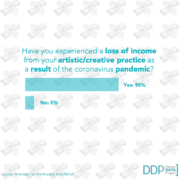
24 April 2020
Artist Relief, the sweeping emergency aid initiative recently launched by seven arts funders, has completed its first funding cycle; with it, research partner Americans for the Arts has published the results of its accompanying COVID-19 Impact Survey, which measures the effect of the coronavirus pandemic on individual artists.
Since applications opened two weeks ago, more than 50,000 artists applied for 200 available unrestricted grants of $5,000 each. Of those applicants, over 11,000 also filled out Americans for the Arts’s survey, among them practicing, teaching, and hobby artists; creative workers; and culture bearers.
The findings paint a bleak picture of the cultural sector’s financial health: nearly two thirds of artists in the US are fully unemployed, and the majority see no clear path to recovery.
Read the full article on Hyperallergic.

 Laurent Liotardo/The English National Ballet