DDP Talks To
"The Devil Ties My Tongue" by Amy Seiwert performed for the SKETCH Series, 2013. Photo by David DeSilva. Courtesy of Amy Seiwert's Imagery
October 16th: Tapestries Choreographic Program, October 20th: 2026 Dance Film Commission, October 20th: SPLIT BILL Series, October 22nd: Perform Europe Open Call, October 30th: Kennesaw State University Choreographic Residency, November 1st: Howard Fellowship, November 5th: CHOP SHOP: Bodies of Work, December 1st: Culture Forward Grant - The Svane Family Foundation Deadline 3, December 1st: Harkness Foundation for Dance Program/Project Grant, December 2nd: NYS Choreographers Initiative (NYSCI), December 31st: National Dance Project Presentation Grants - New England Foundation for the Arts, December 31st: National Dance Project Travel Fund, December 31st: New England Presenter Travel Fund, December 31st: Kit Modus In-person Choreographic Residency
×
"The Devil Ties My Tongue" by Amy Seiwert performed for the SKETCH Series, 2013. Photo by David DeSilva. Courtesy of Amy Seiwert's Imagery

22 May 2020
By Rachel Hellwig
Flocks of swans, waltzing flowers, bourréeing phantoms and leaping princes are all regular sights in rehearsals at Alabama Ballet’s downtown Birmingham studios. Throughout its season, the company produces classical story ballets as well as works by major names like Twyla Tharp, Agnes de Mille and Jiří Kylián. “We’re classically based,” says artistic director Tracey Alvey, who trained at The Royal Ballet School and was a principal with London City Ballet.
But during Alabama Ballet’s annual Ovation showcase, the programming skews more toward the contemporary, as Alvey aims to “give the dancers something to extend their abilities. They need to be versatile, able to jump into any style and excel.” This May, the double-bill features pieces by two female choreographers: the lyrical Donnette Cannonie and German dancemaker Anna Vita.
Springing from three local organizations, Alabama Ballet traces its roots to the early 1980s, and was originally directed by noted Bulgarian dancer Sonia Arova and her husband, Thor Sutowski. Former American Ballet Theatre principal Wes Chapman served as artistic director next, from 1996 until Alvey’s arrival in 2007. Under Chapman’s leadership, the company began to present George Balanchine’s The Nutcracker. In 1998, Alabama Ballet added a school, which became RAD certified under Alvey.
Alabama Ballet performs four main-stage productions per season plus an in-studio show. Story ballets are a staple, so audiences can expect full-lengths—such as Romeo & Juliet, La Sylphide and The Sleeping Beauty—alongside mixed-repertoire programs ranging from classical to contemporary. In recent years, these have included Act II of La Bayadère, Études by Harald Lander, Tharp’s In the Upper Room, de Mille’s Rodeo and Kylián’s Sechs Tänze. Associate artistic director and resident choreographer Roger VanFleteren also produces original work, like Bonnie and Clyde and Alice in Wonderland.
“I love the variety of the repertoire,” says Ariana Czernobil, who’s now in her ninth season. “It’s so different from year to year.” A graduate of University of North Carolina School of the Arts’ high school program, she became acquainted with Alabama Ballet as a teen because her sister was a company member. “Since we’re unranked, there are also opportunities for new dancers to perform solo roles,” says Czernobil. “An apprentice might be cast in the corps and also in a variation. We cheer everyone on.”
Read more here.
18 May 2020
By Emily Stewart
Sheryl Sandberg on the “double-double shift” women are working during the coronavirus.
Amid the coronavirus crisis, millions of Americans are working from home and trying to balance their home lives. And women, specifically, are bearing the brunt of the labor.
New research from Lean In, the women’s organization founded by Facebook COO Sheryl Sandberg, examines how women working from home are faring during the Covid-19 pandemic compared with men. Their findings, at least to many women in that situation, are likely unsurprising: Women with full-time jobs, a partner, and children report spending a combined 71 hours a week on child care, elder care, and household chores — compared with 51 hours for men.
A quarter of women are experiencing physical symptoms of severe anxiety, compared with just 11 percent of men. Women of color are facing an especially tough situation: 75 percent of black and Latina women spend a combined 21-plus hours per week on housework, compared with just over half of white women; they also spend more time on child care and elder care than their white counterparts.
“We know that when things get hard, women get hit the hardest,” says Sandberg. “The double whammy of what happens in the workforce and then what happens to demands on home help has never been higher.”
Read the full article here.
26 March 2020
By Lyndsey Winship
With their 20th anniversary tour now on hold, BalletBoyz rise to meet the challenge of theatreland going digital, taking their new show Deluxe online to launch the Facebook Premieres series from Sadler’s Wells.
No strangers to the screen, directors Michael Nunn and William Trevitt often use behind-the-scenes video to connect with the audience, and this show’s opening dance was always going to be a film. The Intro is a short by new choreographer Sarah Golding. It’s a striking piece with jazz dance flavour, its camp edge offset by the blokeishness of the six dancers, an enjoyable dissonance that whets the appetite for more of Golding’s work.
Nunn and Trevitt are never predictable in their choices of collaborators, giving us the first UK commission for Chinese choreographer Xie Xin. Her piece Ripple would probably have benefitted from being seen live (or at least on a large screen with the lights off), being all about tapping into an energy state, a continuous ebb and flow of rolling tides, the dancers crossing each other’s paths like warp and weft to the raw strings and electronics of Shaofeng Jiang’s score.
Maxine Doyle’s Bradley 4.18 fares well on screen. Renowned as the choreographer behind immersive theatre megastars Punchdrunk, it’s great to see Doyle’s work stand by itself. Rather than a free-roaming experience, there’s focus with just one camera, and it’s beautifully shot and framed (great lighting too, from Andrew Ellis).
Read the full article.
22 May 2020
By Caroline Kitchener
If day cares closed because of the novel coronavirus, Aimee expected her family to fare better than most. She worked full time as the chief executive of a tech company while her husband stayed home. He’d been taking some time off from his own tech career, managing a rental property while considering his options. He could look after their 3-year-old son, she thought — at least for a while.
“That lasted a grand total of three days,” Aimee said. (We have withheld Aimee’s last name and her husband’s name because of threats made against their family.)
Once her son was home full time, she realized they’d need a different solution. She was holed up in the guest room, wielding dual-monitors at her desk. Her husband was exhausted. “I can’t do it,” she remembers him saying: “I can’t watch him for this long.”
Aimee, 46, had been logging 70-hour weeks for years — and she was proud of the work she’d done. When she started her career in San Francisco, she was one of two women at a video game company, buying nondescript jeans and hoodies so she could be “one of the guys.” Eventually she came to run a company she co-founded, building open-source websites for clients like Stanford University. Aimee, who oversaw software development, co-led a diverse team of 13 employees. She was intentional about hiring women, minorities and others who challenged the stereotypes about Silicon Valley.
Read the full article.
22 May 2020
By BWW News Desk
San Francisco Ballet announces further free weekly streams on SF Ballet @ Home, featuring commissioned works from the 2018 Unbound festival and other notable ballets from SF Ballet’s repertory.
For each of the past eight weeks, SF Ballet has streamed a complete ballet from its archives on Facebook, IGTV, YouTube, and the SF Ballet website, calling on regional, national, and international audiences to relish the joy of dance while sheltering in place. SF Ballet @ Home is made possible through the generosity it has received from the community through the Critical Relief Fund. The recordings are produced under agreements with the San Francisco War Memorial and Performing Arts Center, American Guild of Musical Artists, American Federation of Musicians, and International Alliance of Theatrical Stage Employees.
The Friday, June 12 stream will feature Arthur Pita‘s Björk Ballet. In conjunction, SF Ballet will host a virtual, free Nite Out celebration in honor of the 50th anniversary of San Francisco Pride. Nite Out is the Company’s long-running series of performances and post-show parties that celebrate diversity and the LGBTQ+ community through dance. Hosted by an SF Ballet dancer, the June 12 Nite Out celebration includes a Meet the Artist interview on Facebook, DIY cocktail recipes, and a DJ-curated set list.
Over 60% of SF Ballet’s ambitious repertory season was curtailed by the COVID-19 pandemic. To commemorate the artists and creativity of the Company, SF Ballet will stream the complete program from the 2020 Opening Night Gala, Spellbound, on June 26 on SF Ballet @ Home. The stream includes the world premiere performance of Val Caniparoli’s Foreshadow, inspired by the love triangle in Tolstoy’s Anna Karenina, and the SF Ballet premiere of Danielle Rowe’s For Pixie. Other programming highlights include SF Ballet premiere of the pas de deux from David Dawson‘s Swan Lake, danced by departing principal dancers Sofiane Sylve and Carlo Di Lanno, and the world premiere of Myles Thatcher’s 05:49.
Read the full article here.
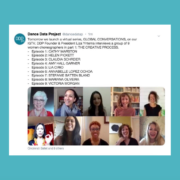
Dance Data Project® (DDP) today introduces Round 1 of Global Conversations – The Creative Process, an ongoing online series of bite-size interviews that feature some of the most notable choreographers, artistic and executive directors, dance critics, and senior academics working in ballet today.
By Sally Jenkins
Lord knows, you need patience right now. Patience with the dime-store elastic biting into your ears from the homemade bandanna mask. Patience with the detergent tang of cleansers in your membranes. What you need to handle all of that is not just patience, but Evert’s particular, stalking brand of it and what it teaches: Patience isn’t complacent. It’s commanding.
Read the full article in the Washington Post.
By Lauren Wolfe
A lament about a lack of productivity runs through social media these days. Coronavirus lockdowns have created a kind of ennui and exhaustion, resulting in people slowing down in general. But in one field—academia—the drop-off for women in particular is measurable. As men have increased their research while home these past couple months, women have lowered their submissions to academic journals, indicating that women are less able to do their research while in stuck in the house.
The speculation began in April. “Negligible number of submissions to the journal from women in the last month,” Elizabeth Hannon, deputy editor of The British Journal for the Philosophy of Science, tweeted on April 18. “Never seen anything like it.”
Women on the thread heartily agreed, offering explanations for what’s going on. “My experience exactly,” replied Columbia University volcanologist Einat Lev. “I just received an email from a male colleague of my same rank and family status (young kids). Except, he has a full-time stay at home wife. His email read ‘this is a strange time but at least now, away from teaching, I can focus on writing.’ Sigh & Scream.”
It’s a stereotypically gendered reality. While stuck at home, mothers in the UK are providing at least 50 percent more childcare overall and spending 10-30 percent more time than fathers home-schooling their children, The Guardian reported in early May—leaving little time for academic research. At the same time, submissions from men to the Comparative Political Studies journal were up almost 50 percent in April, according to its co-editor David Samuels.
Read the full article on Women’s Media Center.

 2020 Dance Data Project