Upcoming Deadlines | click here to see if you are eligible for any of these opportunities

June 1st: Culture Forward Grant - The Svane Family Foundation Deadline 1, July 13th: Community Arts Grant - Zellerbach Family Foundation Deadline 2, September 1st: Culture Forward Grant - The Svane Family Foundation Deadline 2, September 14th: New England Dance Fund, October 13th: Community Arts Grant - Zellerbach Family Foundation Deadline 3, December 1st: Culture Forward Grant - The Svane Family Foundation Deadline 3, December 31st: National Dance Project Presentation Grants - New England Foundation for the Arts, December 31st: National Dance Project Travel Fund, December 31st: New England Presenter Travel Fund

×

Best Practices and Guidelines for Ballet and Dance School Safety

Marika Brussel and Peninsula Ballet Theatre in California
Rehearsal images for Brussel’s new work “Slant of the Earth”
Photo by Elizabeth Langfeld

In the following section, we’ve provided checklists, links, and other resources focused on student and professional dancer safety, particularly regarding sexual harassment and assault. These resources include guidelines for implementing dancer safety, examples of codes of conduct, information on allied organizations, legal advice, and ideas for increased inclusivity and advocacy.

The following are guidelines and best practices for ballet and dance schools related to student safety, reporting, and policy. This is not meant to be exhaustive, but rather a list of practical ideas to implement in order to ensure students are kept safe and free from harm. This document will also be reviewed and updated on a regular basis.

AT THE STUDIO

    • Keep the studio door open or ensure there is an observation window.
    • Hold classes, rehearsals, and/or coaching sessions within official business/studio hours only; if classes are held outside official hours, students should be accompanied by at least one other person.
    • Keep separate restrooms and dressing rooms for staff and students and should never permit an opposite gendered student or teacher/administrator or faculty member to enter the dressing room for any reason. This includes directors and choreographers.
    • Institute a Code of Conduct that is required to be signed annually by staff and students and anyone teaching or working with students or company members.
    • Use “students” or other gender-inclusive language, as opposed to “men/boys” or “girls/ladies”.
    • Ask for consent before correcting a student with touch in classes, rehearsals, and/or coaching sessions.
    • Establish a system in which at least two staff members are present when meeting privately with students.
    • Set up a system in which at least two staff members are present when doing costume fittings.
    • No teacher or person in power should provide any services such as “therapy” or massage, except designated trained personnel.
    • Require references for any prospective instructor or staff member, preferably from another dance studio or school.
    • Implement a criminal background check protocol in place for current and future instructors even if a “guest artist” for a single day or weekend or a “last minute replacement”.
    • Ensure a designated person on staff has Mental Health & First Aid Training and is known and available as a resource
    • Resolve conflict effectively and respectfully and insist that others do the same.
    • Create a ”Sexual Harassment” reporting protocol that is simple and clear for students, parents, trainees, and company members that does not include faculty or administrator on staff with direct supervision of student or company member.
    • Ensure all constituents know where and how to report concerns in their area, their school, and/or their organization.
    • Ensure the protocol contains a plan, a contact person, and a contact email/phone, so that affected individuals do not have to try to locate it under stress should a concern arise.
    • Publish the reporting protocols in the school handbook and make them visible on the website and in the studio.

OUTSIDE THE STUDIO

    • Refrain from social media interaction between staff and students or trainees.
    • Maintain a “Social Media Policy” in which correspondence takes place only through the organization’s email or main phone line
    • Avoid shared car rides between staff and students/trainees
    • Establish a buddy system for students/trainees, so during breaks they are not going anywhere alone

SUMMER INTENSIVES AND RESIDENTIAL PRE-PROFESSIONAL PROGRAMS

    • Ensure an orientation to the city includes maps and access to public transportation or that transportation is provided to students via chartered bus or other transportation.
    • Discuss your “Social Media Policy” with students and how texting and online chat rooms it can be used by predators.
    • Communicate rules and regulations on the ”Code of Conduct”  in a consistent and clear manner.
    • Outline a reporting mechanism for any issues and the process by which the reporting will be handled. Every effort should be made to ensure the reporting protocols include someone outside of the staff.
    • Create a safe living environment that keeps students safe.
    • Provide written rules”Code of Conduct” for both student and guest teachers.
    • Keep correspondence between dorm students and minors via text professional and informational at all times.

DDP wishes to offer its sincere gratitude to the following individuals and organizations, who collaborated on this document.

  • Ty Woodfolk
    Director of Human Resources, Diversity, and Inclusion, Chicago Shakespeare Theater
    DDP Advisory Council Member
  • Erin Sanchez
    Manager of Health, Wellbeing, and Performance for One Dance UK
  • Emma Lister
    Podcast Host, MOVERS SHAKERS MAKERS
    Co-Director, Makeshift Company
  • Zoë Ashe-Browne
    Choreographer
    Podcast Co-Host, MOVERS SHAKERS MAKERS
  • Whistle While You Work: Robyn Doty and Frances Chiaverini

Dance Company Checklist:
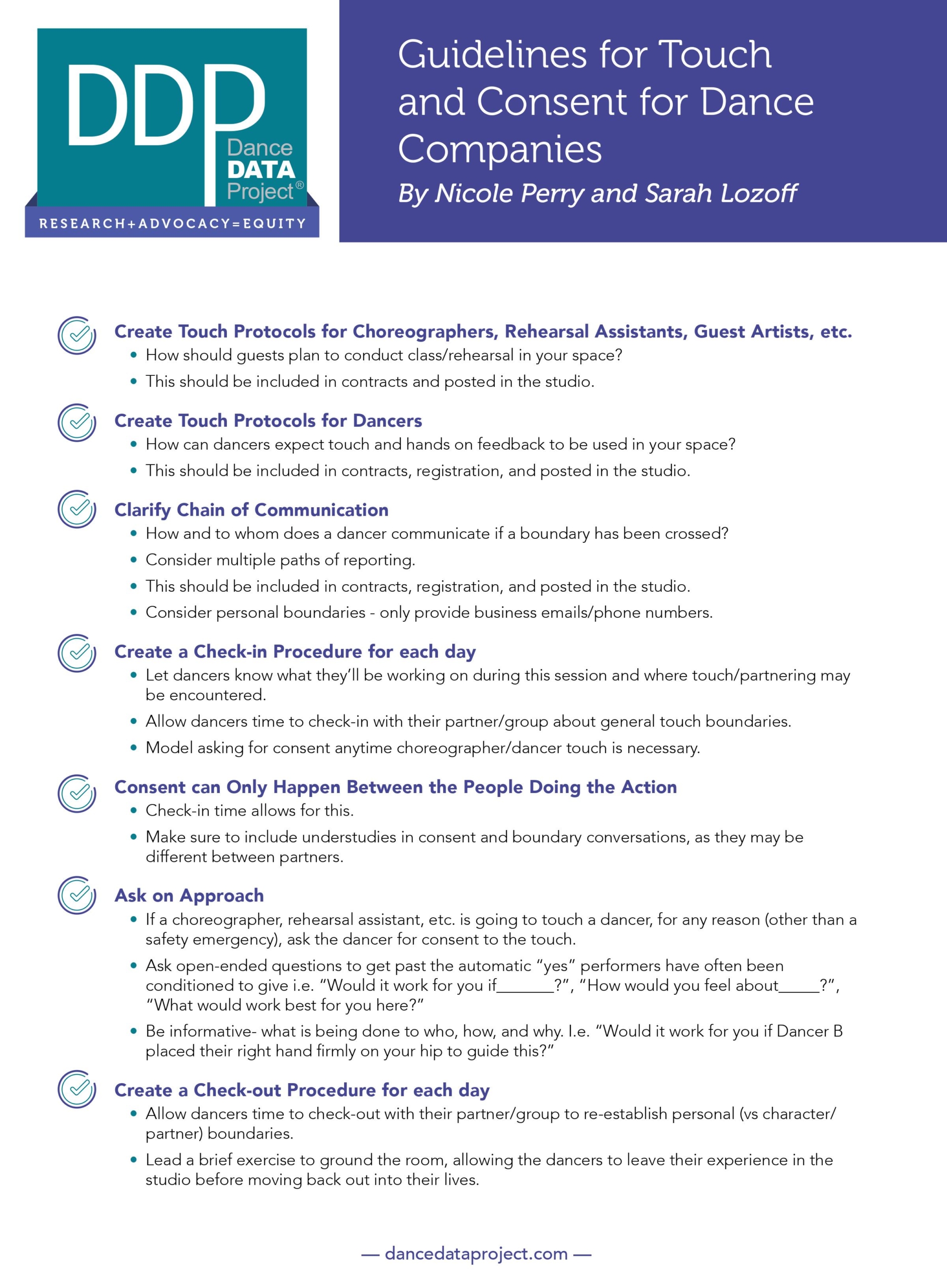
Guidelines for Touch and Consent

By Nicole Perry and Sarah Lozoff


Students and professional dancers alike are subject to an inequitable balance of power in the studio with their superiors. The mentor-mentee dynamic central to the traditional, touch-driven teaching of dance leaves dancers vulnerable to abuse of this power.  Intimacy experts Nicole Perry and Sarah Lozoff have created Guidelines for Touch and Consent as a way to protect dancers from the abuses plaguing our headlines and  respect the sensitivity of the art form.

Nicole Perry is an intimacy choreographer and coordinator, as well as director and choreographer in South Florida. Career highlights include a Broward County Artist Investment Grant for KINesphere, intimacy coordination for the award-winning short film Arena, choreography and intimacy direction for the US premiere of The Glass Piano at Theatre Lab, and resident intimacy choreographer for Measure for Measure Theatre. She is also Certified Laban/Bartenieff Movement Analyst. Nicole teaches in the dance department at the University of Miami.
Nicole has recently published various articles in Dancegeist Magazine.  You can access them below:

Creating a Culture of Consent in Dance. Dancegeist Magazine. April 2021.

Disrupting Oppressive Patterns of Powers in Dance. Dancegeist Magazine. March 2021.

History of Power Dynamics in Dance. Dancegeist Magazine. Feb. 2021. 

Read more about Nicole here.

Sarah Lozoff (SDC) is the resident intimacy director for both the Oregon Shakespeare Festival and RudduR Dance, as well as the first intimacy director to work with American Ballet Theatre, on the groundbreaking commissioned work, Touché. She is the intimacy direction consultant for ABT’s Fall 2021 season, as well as a certified Gyrotonic trainer, movement director, and a partner with Production on Deck.

Read more about Sarah here.

VIEW THE CHECKLIST

Inclusive Technique Class Checklist:
Creating A Safe Dance Environment

By Gretchen Alterowitz


Western concert dance techniques are often taught in an authoritarian manner, which separates the roles of instructors and students by demarcating who holds power and knowledge (instructors), and who is subject to power and needs to gain knowledge. Authoritarian models, while sometimes defended for their rigor or results, can be abusive (emotionally, psychologically, physically) and lead to fear, anxiety, and injury. Intimidated dancers are less creative, exploratory, and willing to take risks, and their capacity to learn and develop is diminished. Inclusive teaching reimagines traditional ideas about who can and should dance and what the studio environment should feel like, with the goal of creating equity, care, and growth opportunities for all participants.

USE CHOSEN PRONOUNS

    • Ask students for their chosen names and pronouns at the start of every term, and make sure to use them consistently.
    • Model this to the students in how you introduce yourself; tell students how to refer to you and what pronouns you use.
    • If you slip and use the wrong name or pronoun for a student, simply correct yourself and apologize.
    • Knowing that pronouns and names may change over time, it’s a good idea to do this every term.

EXPAND YOUR DRESS CODE

    • Dress and grooming codes based on gender or race can discourage students from participating in dance classes.
    • Religious considerations may also apply to such decisions.
    • Giving students choices allows them to enter the classroom from a self-defined position.
    • Ask yourself if your dress or grooming code is based on gendered or racialized assumptions, or is exclusionary in other ways, and consider other options that can support the technique.

ASK FOR PERMISSION TO TOUCH (EVERY TIME)

    • If physical corrections are necessary, ask students for permission to touch and manipulate their bodies, and be prepared for them to say no.
    • Direct students to ask for permission to touch in partner exercises.
    • Do not assume that previously-given permission grants consent every time – students’ bodies, experiences, and needs may change.
    • Develop non-physical options for corrections.

    ACKNOWLEDGE ANATOMY

    • Anatomical differences create opportunities and challenges, and some aesthetics will not be accomplishable by every body. For example, the angle and shape of the femur’s neck, as well as the orientation of the acetabulum, affect how much turnout a dancer can achieve. And while deviations in spinal alignment or hypermobility may increase a dancer’s ability to achieve certain lines and positions, they may also increase pain and injury. Work with individual students to identify, understand, and value their own bodies’ capacities.

USE DIVERSE EXAMPLES

    • If you provide examples (from historical sources, the professional world, music, etc.), share a variety of bodies, genders, races, cultures, and abilities.
    • When choosing class demonstrators, select different students each time.

ENCOURAGE DISCUSSION AND DISSENT

    • Students learn, process information, and demonstrate their abilities in a variety of ways.
    • Encouraging students to voice their ideas creates an environment where knowledge and power are shared among participants.
    • Emboldening students to draw from their personal experiences demonstrates that the information they bring into the room matters.

REMEMBER INTERSECTIONALITY

    • Identities overlap, and students’ experiences and ways of being are shaped by multiple, intersecting identities. Yours are too.
    • Take stock of any assumptions you may make about students’ behavior, work ethic, and attitude. Pursue information about identities that are unfamiliar to you.

SELF-REFLECT FOR BIAS

    • Turn your attention inward to ask yourself how you are perpetuating traditional narratives around gender, race, class, sexuality, bodies, and ability. This is ongoing work.

(RE)CHECK AND EXPAND THE LIST

    • Things change – while a checklist implies a stable set of circumstances, it is essential to tune in to social, cultural, and political moves.
    • Be willing (maybe eager) to change and incorporate new understandings.

Safer Dance
Created by like-minded academics and professionals in the dance school and safeguarding sectors, Safer Dance’s mission is to help protect children and vulnerable adults who attend dance teaching in out-of-school settings (“the sector”) in the UK by supporting and facilitating the implementation of high standards of safeguarding.

Youth Protection Advocates in Dance
YPAD believes that when you know better, you do better. As a result, YPAD courses are research based, educational courses with a trauma-informed approach for dance professionals and the dance industry as a whole. The mission of Youth Protection Advocates in Dance® is to provide dance professionals with the skills and resources to protect and develop healthy, happy dancers. Through the use of online courses, YPAD courses educate dance studios and communities worldwide on the core elements in constructing an environment focused on the well-being of kids and a sustainable, safe future for dance.

The National Association of Blacks in Dance
The International Association of Blacks in Dance (IABD) preserves and promotes dance by people of African ancestry or origin, and assists and increases opportunities for artists in advocacy, audience development, education, funding, networking, performance, philosophical dialogue, and touring. Their vision is for dance, by people of African ancestry or origin, to be revered, respected, and preserved in the consciousness and cultural institutions of all people.