DDP Talks To
"The Devil Ties My Tongue" by Amy Seiwert performed for the SKETCH Series, 2013. Photo by David DeSilva. Courtesy of Amy Seiwert's Imagery
October 16th: Tapestries Choreographic Program, October 20th: 2026 Dance Film Commission, October 20th: SPLIT BILL Series, October 22nd: Perform Europe Open Call, October 30th: Kennesaw State University Choreographic Residency, November 1st: Howard Fellowship, November 5th: CHOP SHOP: Bodies of Work, December 1st: Culture Forward Grant - The Svane Family Foundation Deadline 3, December 1st: Harkness Foundation for Dance Program/Project Grant, December 2nd: NYS Choreographers Initiative (NYSCI), December 31st: National Dance Project Presentation Grants - New England Foundation for the Arts, December 31st: National Dance Project Travel Fund, December 31st: New England Presenter Travel Fund, December 31st: Kit Modus In-person Choreographic Residency
×

"The Devil Ties My Tongue" by Amy Seiwert performed for the SKETCH Series, 2013. Photo by David DeSilva. Courtesy of Amy Seiwert's Imagery

By Claire Cain Miller
1 May 2018
Aileen Rizo was training math teachers in the public schools in Fresno, Calif., when she discovered that her male colleagues with comparable jobs were being paid significantly more.
She was told there was a justifiable reason: Employees’ pay was based on their salaries at previous jobs, and she had been paid less than they had earlier in their careers.
Ms. Rizo, who is now running for the California State Assembly, sued. In April, the United States Court of Appeals for the Ninth Circuit ruled in her favor, saying that prior salary could not be used to justify a wage gap between male and female employees.
It’s the latest sign that this has become the policy of choice for shrinking the gender pay gap. Several states, cities and companies have recently banned asking about salary history. They include Massachusetts, California, New York City and Chicago, as well as Amazon, Google and Starbucks.
Read the full article in The New York Times.
Birmingham Royal Ballet is proud to announce a first-of-its-kind collaboration with the multi-awarding Ballet Black, a company dedicated to increasing diversity in ballet, founded and directed by Ballet Now Creative Consortium member, Cassa Pancho. Dancers of both Birmingham Royal Ballet and Ballet Black will appear in this exciting triple bill.
The bill opens with the fourth Ballet Now commission, from young choreographer and Queensland Ballet dancer Jack Lister and composer Tom Harrold. Second is Cathy Marston’s moving tale of a broken marriage, the critically acclaimed and National-Dance-Award-winning ballet The Suit, in its first UK performances outside London. The bill will close with Twyla Tharp’s sizzling tribute to Old Blue Eyes, Nine Sinatra Songs.
Learn more about the exciting initiative here.
By Lizzy Goodman
10 June 2019
In spring 2018, Abby Wambach, the most decorated soccer player in American history, gave a commencement address at Barnard College that went viral. The player who had scored more goals than any other, male or female, in international competition described standing onstage at the ESPYs the year after she retired in 2015, receiving the Icon Award alongside two peers, Peyton Manning and Kobe Bryant. “I felt so grateful,” she recalled. “I had a momentary feeling of having arrived; like, we women had finally made it.” As the athletes exited the stage, each having, as Wambach put it, “left it all on the field for decades with the same ferocity, talent and commitment,” it occurred to her that while the sacrifices the men made for their careers were nearly identical to her own, their new lives would not resemble hers in one fundamental way. “Kobe and Peyton walked away from their careers with something I didn’t have: enormous bank accounts,” Wambach said. “Because of that, they had something else I didn’t have: freedom. Their hustling days were over; mine were just beginning.”
The United States women’s national team is the best in the world and has been for decades. Since the FIFA Women’s World Cup was inaugurated in 1991, the United States has won three of the seven titles, including the most recent one in 2015. Since women’s soccer became an Olympic sport in 1996, it has won four of six gold medals. The team has been ranked No.1 by FIFA for 10 of the last 11 years and has produced some of the biggest female sports stars of the last several decades, from Mia Hamm to Wambach to the current starting center forward, Alex Morgan.
Read the full article in The New York Times.
By Nancy Coleman
9 June 2019
In a Broadway season nearly devoid of female directors, the sole woman at the helm of a musical this year — Rachel Chavkin, director of “Hadestown” — took home the Tony Award for best direction of a musical.
Ms. Chavkin, who was previously nominated in the category for “Natasha, Pierre & The Great Comet of 1812” in 2017, emphasized diversity in the industry in her acceptance speech Sunday night.
“There are so many women who are ready to go. There are so many artists of color who are ready to go. And we need to see that racial diversity and gender diversity reflected in our critical establishment, too,” Ms. Chavkin said in her speech. “This is not a pipeline issue. It is a failure of imagination by a field whose job is to imagine the way the world could be.”
Read the full article in The New York Times.
This year Freed of London have teamed up with Ballet Black founder and artistic director Cassa Pancho MBE and Senior Artist Cira Robinson to create the first skin tone pointe shoes, handmade in the U.K. for black, Asian and mixed race dancers.
After over a year in development, Freed of London has introduced new colours ‘Ballet Bronze’ and ‘Ballet Brown’ to their core collection. The Freed of London ethos has always been to develop shoes to meet the needs of each generation of dancer and these new colours continue to reflect this.
“This wouldn’t of been achievable without the help of everyone involved, especially “Ballet Black” whom we collaborated with to create these beautiful new colours.”
– Freed of London
“I am beyond delighted that Freed have launched these two new colours. Although it may seem like a very small change to the outside world, I believe this is an historic moment in British ballet history and another step forward for culturally diverse dancers across the globe who wear the iconic Freed brand of shoe.
I would like to thank Freed for using their platform to help instigate change, and Cira Robinson, Senior Artist at Ballet Black, for her unending dedication to making this possible.”- Cassa Pancho MBE, Founder & Artistic Director
Read about the collaboration here.
Part of what is holding women back from leadership in ballet is a challenge for women in every field: parenting.
Maya Salam explores this topic in her latest ‘In Her Words’ for The New York Times below:
The invisible, unpaid work that women are often expected to shoulder — like raising children and managing households — is an “urgent matter” of gender justice, according to a new report on modern fatherhood.
The report, The State of the World’s Fathers, which examines data from over two dozen countries and information from nearly 12,000 people, was released this week by Promundo, a global advocacy group focused on gender-equality issues, and MenCare, a campaign focused on men’s family involvement.
Its major finding: that women still spend way more time than men, up to 10 times as much, on unpaid tasks like child care and senior care, as well as on volunteer work and domestic chores.
Read the full article in The New York Times.
By Rebecca Stanley
6 June 2019
Dutch choreographer Didy Veldman has created a brand-new piece for the [Un]leashed triple bill, Sense of Time has been commissioned by BRB as part of their Ballet Now programme and will receive its World Premiere in Birmingham.
“It’s a very physical work. Physical, theatrical, accessible, hopefully touching. A realisation of how we deal with time in our current society,” she says.
“It wasn’t a lightbulb moment, but it is something I’ve been interested in for a while. I am curious about how our society perceives time, why it is so difficult for instance to make time available for each other or for certain moments in our lives.
“Are we slaves to time, always running and catching up with the latest technology, or are we in charge of our own time? Are our dealings with time dependent on our surroundings and how does time manifest itself physically?
“These questions and many more are part of the inspiration of Sense of Time.”
Read the full article in the Shropshire Star.
By Roslyn Sulcas
4 June 2019
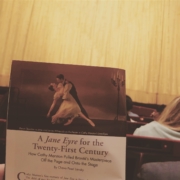
“You feel trapped, like the walls are closing in,” said the ballet mistress, demonstrating a sequence of frantic, elbow-jutting arms. “Keep the legs low, it’s not about the height, it’s about wanting to get out of here.”
Devon Teuscher, Misty Copeland and Isabella Boylston, the American Ballet Theater principals who are all cast in the title role in Cathy Marston’s “Jane Eyre,” opening at the Metropolitan Opera House on Tuesday, listened intently as they copied the movements and tried to absorb the intentions behind them. It was February, and an early rehearsal for the full-length ballet, based on Charlotte Brontë’s 1847 novel.
With its first-person narrative and intense focus on an interior consciousness, Brontë’s novel isn’t an obvious candidate for a ballet. But Ms. Marston, 43, a British choreographer who has slowly forged a reputation for her ability to create narrative works, seems undaunted by the challenges of transmuting literary complexity into dance.
It was the strength and unpredictability of Jane’s character that attracted her, she said, adding that she was often drawn to strong women as protagonists, including Mrs. Alving in Ibsen’s “Ghosts,” Cathy in “Wuthering Heights” and Queen Victoria — all characters around whom she has created ballets.
Read the full article in The New York Times.
By Marissa DeSantis
4 June 2019
Though Australian Ballet coryphée Alice Topp has been dancing since she was four, when it comes to choreographing, she’s just getting started. Topp created her first piece, Trace, on a whim in 2010 as part of The Australian Ballet’s annual Bodytorque program. Since then, she has gone on to make several main stage works for the company, as well as music videos for artists like Ben Folds and Megan Washington; in 2018 she was named one of the The Australian Ballet’s resident choreographers.
Topp plays what she calls “a fine Tetris” to balance her responsibilities as both dancer and choreographer. Yet despite her jet lag and packed schedule of rehearsals and sightseeing, she was bursting with energy when we met in New York during The Australian Ballet’s visit to the Joyce Theater last month, where her ballet Aurum was given its US premiere. “This is the first time my work is being performed overseas,” she says. “To be able to bring it to New York, which is my favorite city in the world—what a debut!”
…
“I think the lack of female choreographers in ballet comes down to a combination of things, and I can only share this from my own experience. It’s not necessarily that the women work a lot harder, but we tend to be there until the end of the night in a lot of those big classical ballets. In Swan Lake, the guys are done after Act III, and we’re there at the very end—it’s the same with Giselle and the Willis and La Bayadère with the Kingdom of the Shades. I think it can be more demanding as a corps.
“Another big thing is just the nature of the work doesn’t lend itself to the individual artistic voice, so you never really nurture that. Those big scenes—the swans, shades, snowflakes, flowers—are about the women dancing in unison, and the guys don’t do as much of that. I think the guys tend to get away with a bit more individualism, and if they’ve got a bit of chutzpah and cowboy attitude, they stand out and it’s rewarded. Whereas women are taught to conform and to fit in, and not to stand out for the wrong reasons. Your goal for the first few years in the company is about fitting in—if you’re one of 24 swans and you spend all day, every day, thinking, ‘Is my arm higher than the other person?,’ or ‘I’m not on the red mark,’ you’re not exploring and exercising that creative part of your brain that’s making different artistic choices.
Read the full article on Pointe’s blog.
By Chloe Angyal
15 March 2017
Ballerina Ashley Bouder is crying. She’s standing alone in a rehearsal studio in front of 20 or so dance journalists and several funders of her small self-titled ballet company, and she’s crying. And I’m pretty sure it’s my fault.
She’s just finished showing us a snippet of pas de deux that she choreographed, and that she’ll perform in just over a week’s time with her fellow New York City Ballet principal dancer Andrew Veyette. The entire evening of dancing is devoted to women choreographers and to women composers. In over 15 years of dancing with City Ballet, Bouder tells the assembled crowd, she’s danced works by about 40 choreographers and can count only seven women among them. She can’t name a single woman composer whose music she’s danced to ― not a single one.
Which brings us to why Bouder is crying. I’ve asked her why it matters to her that more women be allowed to choreograph ballets. What does gender have to do with it?, I ask, channeling the purportedly gender-blind proponents of pure, context-free meritocracy. Ballet is ballet, right? Does it really make a difference if it’s made by a man or a woman?
She takes a deep breath, and begins to answer, her voice breaking before she can get more than a few words out. “I think a lot of it is about telling little girls that they can. I have a daughter. As a kid, I was told that I can’t, a lot. For me, to have my voice be relevant, and for people to listen, is really important. To say what I have to say, even if they don’t like it. I get to say it.” The room erupts into applause, and Bouder wipes her eyes and nods, her short brown ponytail bobbing.
Read the full article on HuffPost.