DATA BYTE:
The Largest 150 U.S Contemporary and Modern Dance Companies Gender Leadership Distribution + Compensation
March 4th, 2026
April 13th: Community Arts Grant - Zellerbach Family Foundation Deadline 1, April 17th: World Arts West (WAW) Cultural Dance Catalyst Fund, April 21st: Works and Process Residency, June 1st: Culture Forward Grant - The Svane Family Foundation Deadline 1, July 13th: Community Arts Grant - Zellerbach Family Foundation Deadline 2, September 1st: Culture Forward Grant - The Svane Family Foundation Deadline 2, September 14th: New England Dance Fund, October 13th: Community Arts Grant - Zellerbach Family Foundation Deadline 3, December 1st: Culture Forward Grant - The Svane Family Foundation Deadline 3, December 31st: National Dance Project Presentation Grants - New England Foundation for the Arts, December 31st: National Dance Project Travel Fund, December 31st: New England Presenter Travel Fund
×

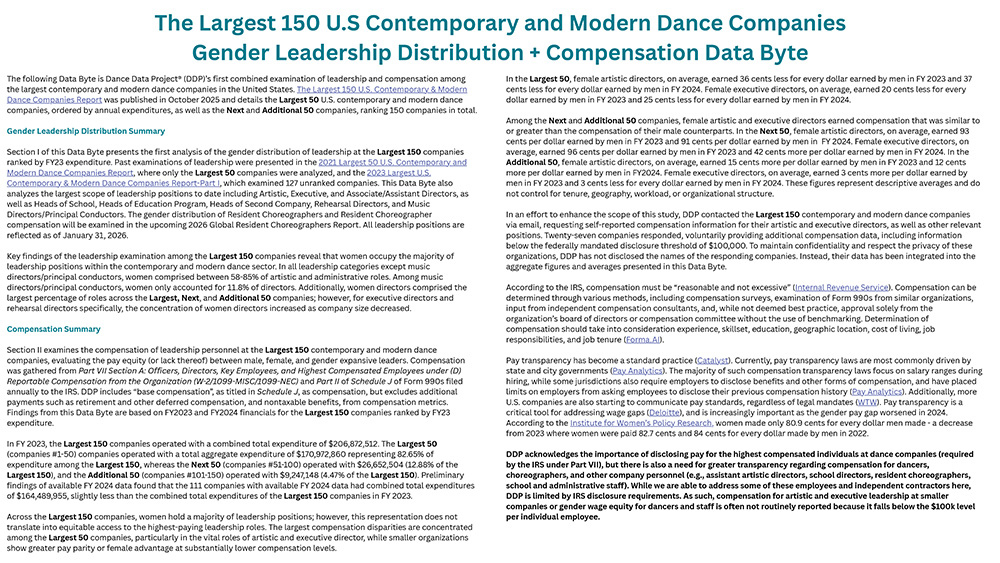
The following Data Byte is Dance Data Project® (DDP)’s first combined examination of leadership and compensation among the largest contemporary and modern dance companies in the United States. The Largest 150 U.S. Contemporary & Modern Dance Companies Report was published in October 2025 and details the Largest 50 U.S. contemporary and modern dance companies, ordered by annual expenditures, as well as the Next and Additional 50 companies, ranking 150 companies in total.
Gender Leadership Distribution Summary
Section I of this Data Byte presents the first analysis of the gender distribution of leadership at the Largest 150 companies ranked by FY23 expenditure. Past examinations of leadership were presented in the 2021 Largest 50 U.S. Contemporary and Modern Dance Companies Report, where only the Largest 50 companies were analyzed, and the 2023 Largest U.S. Contemporary & Modern Dance Companies Report-Part I, which examined 127 unranked companies. This Data Byte also analyzes the largest scope of leadership positions to date including Artistic, Executive, and Associate/Assistant Directors, as well as Heads of School, Heads of Education Program, Heads of Second Company, Rehearsal Directors, and Music Directors/Principal Conductors. The gender distribution of Resident Choreographers and Resident Choreographer compensation will be examined in the upcoming 2026 Global Resident Choreographers Report. All leadership positions are reflected as of January 31, 2026.
Key findings of the leadership examination among the Largest 150 companies reveal that women occupy the majority of leadership positions within the contemporary and modern dance sector. In all leadership categories except music directors/principal conductors, women comprised between 59-85% of artistic and administrative roles. Among music directors/principal conductors, women only accounted for 11.8% of directors. Additionally, women directors comprised the largest percentage of roles across the Largest, Next, and Additional 50 companies; however, for executive directors and rehearsal directors specifically, the concentration of women directors increased as company size decreased.
Compensation Summary
Section II examines the compensation of leadership personnel at the Largest 150 contemporary and modern dance companies, evaluating the pay equity (or lack thereof) between male, female, and gender expansive leaders. Compensation was gathered from Part VII Section A: Officers, Directors, Key Employees, and Highest Compensated Employees under (D) Reportable Compensation from the Organization (W-2/1099-MISC/1099-NEC) and Part II of Schedule J of Form 990s filed annually to the IRS. DDP includes “base compensation”, as titled in Schedule J, as compensation, but excludes additional payments such as retirement and other deferred compensation, and nontaxable benefits, from compensation metrics. Findings from this Data Byte are based on FY2023 and FY2024 financials for the Largest 150 companies ranked by FY23 expenditure.
Across the Largest 150 companies, women hold a majority of leadership positions; however, this representation does not translate into equitable access to the highest-paying leadership roles. In the Largest 50, female artistic directors, on average, earned 36 cents less for every dollar earned by men in FY 2023 and 37 cents less for every dollar earned by men in FY 2024. Female executive directors, on average, earned 20 cents less for every dollar earned by men in FY 2023 and 25 cents less for every dollar earned by men in FY 2024.
It is important to note that the gender pay gap calculations for the Largest 50 companies include significant outliers, and when these outliers are removed, the gender pay gap decreases remarkably. The gender pay gap for the Largest 50 artistic directors decreases from $0.36 to $0.13 per dollar earned by men in FY23 and $0.37 to $0.03 per dollar in FY24. The gender pay gap for the Largest 50 executive directors decreases from $0.20 to $0.01 per dollar earned by men in FY23 and $0.25 to $0.01 per dollar in FY24.
Among the Next and Additional 50 companies, female artistic and executive directors earned compensation that was similar to or greater than the compensation of their male counterparts. In the Next 50, female artistic directors, on average, earned 93 cents per dollar earned by men in FY 2023 and 91 cents per dollar earned by men in FY 2024. Female executive directors, on average, earned 96 cents per dollar earned by men in FY 2023 and 42 cents more per dollar earned by men in FY 2024. In the Additional 50, female artistic directors, on average, earned 15 cents more per dollar earned by men in FY 2023 and 12 cents more per dollar earned by men in FY2024. Female executive directors, on average, earned 3 cents more per dollar earned by men in FY 2023 and 3 cents less for every dollar earned by men in FY 2024. These figures represent descriptive averages and do not control for tenure, geography, workload, or organizational structure.


 Ballet Artistic and Executive Compensation Report 2026