

DANCE DATA PROJECT®RELEASES INAUGURAL GENDER & COMPENSATION STUDY OF THE LARGEST 150 CONTEMPORARY & MODERN U.S.-BASED DANCE COMPANIES, FINDING THAT WOMEN HOLD BETWEEN 59-85% OF ARTISTIC AND ADMINISTRATIVE LEADERSHIP ROLES
Northfield, IL | March 4, 2026 | Dance Data Project® today announced publication of the first Gender Leadership Distribution & Compensation Study of the Largest Contemporary & Modern U.S.-Based Dance Companies. This Data Byte is the first-ever combined examination of leadership and compensation among the largest contemporary and modern dance companies in the United States.
Report Lead and author Junyla Silmon explained that this analysis covers the largest number of companies to date, as well as examines a broad array of roles, including artistic & executive directors, associate/assistant artistic directors, heads of school, heads of education program, heads of second company, rehearsal directors, and music directors/principal conductors. This study also represents DDP’s first examination of leadership compensation within the contemporary and modern dance sector.
DDP finds that in the Largest 150 companies by FY23 expenditure, women hold a majority of leadership positions. In all leadership categories except music directors/principal conductors, women comprised between 59 and 85% of artistic and administrative roles. Among music directors/principal conductors, women only accounted for 11.8% of directors.
Although women hold a majority of leadership positions, this representation does not translate into equitable access to the highest-paying leadership roles. The most glaring gender-based compensation disparities are concentrated among the Largest 50 companies, particularly in the vital roles of artistic and executive director, while smaller organizations show greater pay parity, though at substantially lower compensation levels.
“This landmark study represents further elaboration and a deep dive by Dance Data Project®,” stated Research Lead Jenna Magrath. She continued, “Without financial transparency, donors, audiences, Boards of Directors, and artists themselves struggle to make fact-based arguments around the continuing gender pay gap.” Added External Communications Lead Nancy Dobbs Owen, “As a working dance artist and educator, this information is essential to evaluate dance as an economic sector and career path.”
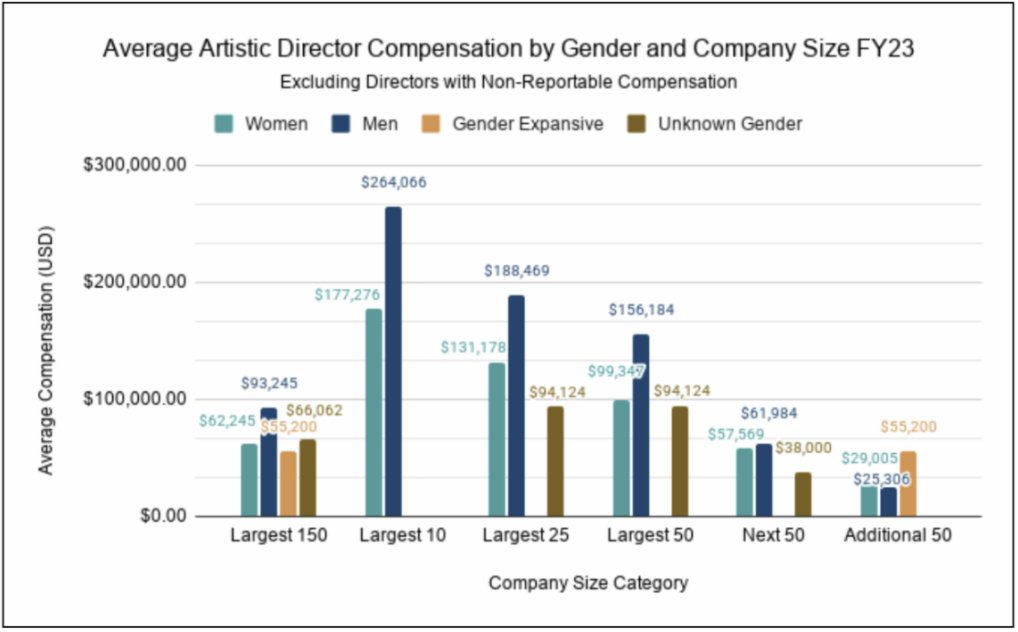
Key Finding: In the Largest 50, female artistic directors, on average, earned 36 cents less for every dollar earned by men in FY 2023, and 37 cents less for every dollar earned by men in FY 2024. Female executive directors, on average, earned 20 cents less for every dollar earned by men in FY 2023 and 25 cents less for every dollar earned by men in FY 2024.
NOTE: The artistic and/or executive director compensation of Alvin Ailey American Dance Theater, Gibney Company, Mark Morris Dance Group, Bill T. Jones/Arnie Zane Company, Martha Graham Dance Company, Paul Taylor Dance Company, and Hubbard Street Dance Chicago are outliers within this study. These seven companies report 11 artistic and executive directors who earn over $200,000 annually. With the exclusion of these companies, the FY23 gender pay gap decreases from $0.36 to $0.13 for every dollar made by male counterparts. For FY 2024, removing the same outlier companies’ artistic director pay decreases the gender pay gap from $0.37 to $0.03 for every dollar made by male counterparts.
For the FY23 Largest 50 executive directors, the gender pay gap decreases from $0.20 to $0.01 per dollar with the exclusion of those seven companies. Removing the same seven outlier companies, in FY 2024, the gender pay gap decreases from $0.25 to $0.01 per dollar.
In the Next 50, female artistic directors, on average, earned 93 cents per dollar earned by men in FY 2023 and 91 cents per dollar earned by men in FY 2024. Female executive directors, on average, earned 96 cents per dollar earned by men in FY 2023 and 42 cents more per dollar earned by men in FY 2024.
Mirroring a pattern within the ballet sector, DDP found that smaller companies by expenditure within the contemporary and modern sector support women more. In the Additional 50, female artistic directors, on average, earned 15 cents more per dollar earned by men in FY 2023 and 12 cents more per dollar in FY2024. Female executive directors, on average, earned 3 cents more per dollar earned by men in FY 2023 and 3 cents less per dollar in FY 2024. Stay tuned for our companion report on the Largest 150 classically based companies.
NOTE: This analysis represents descriptive averages and does not control for important factors such as tenure, geography, workload (especially for combined CEO/AD roles), or organizational structure.
“We believe it’s important to evaluate the contemporary & modern sector with the same scope and rigor DDP brings to the economic analysis of classically based companies,” stated Junyla Silmon, the chief architect of this new study, and added, “We are immensely grateful to the growing number of companies who have chosen to self report compensation in the aid of greater transparency and for the ability to accurately benchmark by budget tier.”
Elizabeth “Liza” Yntema, President & Founder, added, “Obviously, this is a major undertaking, and as a small not-for-profit, we must carefully consider what work we can accomplish, but this Data Byte is a crucial piece of the puzzle for those looking at who benefits from the current system.”
The Largest 150 U.S Contemporary and Modern Dance Companies Gender Leadership Distribution + Compensation Data Byte is available for download on the Dance Data Project® Research Page.