

DANCE DATA PROJECT® RELEASES SEVENTH ANNUAL SEASONAL OVERVIEW, COVERING THE 2024-2025 SEASON
The report highlights broad gains for women choreographers while revealing
substantial gaps in the commissioning and retention of large-scale works.
Northfield, IL | July 20, 2026 | Dance Data Project® (DDP) announced today the release of its 73rd publicly available study, the 2024-2025 Season Overview. This is DDP’s seventh annual examination of choreographic commissions from the Largest 150 U.S. ballet and classically based companies. The report analyzes 1,626 works, a notable expansion from the inaugural 2019 Season Overview’s 645 works. The findings present a mixed picture: broad-based gains for women choreographers alongside stubborn gaps in the commission of large-scale, full evening works.
“The value of this dataset, seven editions in, is longitudinal,” said Isaac A. Garcia, Research Lead. “We are no longer measuring a single season but a trajectory: 1,626 works, tracked not only by who is commissioned but by how often each work is performed,” He added. “What 2024-2025 Season Programming Report confirms is a decoupling. Women have reached parity in the creation of new work, but their works are performed less often once programmed. Whether those premieres enter the standing repertoire, and at what performance frequency, may be a more telling measure of equity in the field.”
Women choreographed 32.9% of all works presented in 2024-2025, up from 30.6% the prior season. Their share increased across every budget tier examined, but the greatest gain came where it has historically been scarcest – the Largest 10. Report Co-Lead Margaret Brewer noted, “After four sequential decreases, the 2024-2025 season saw the Largest 10 reach its highest share of works choreographed by women, rising from 14.6% to 19.2%.”
Figure 1: All Works – Choreographer Gender
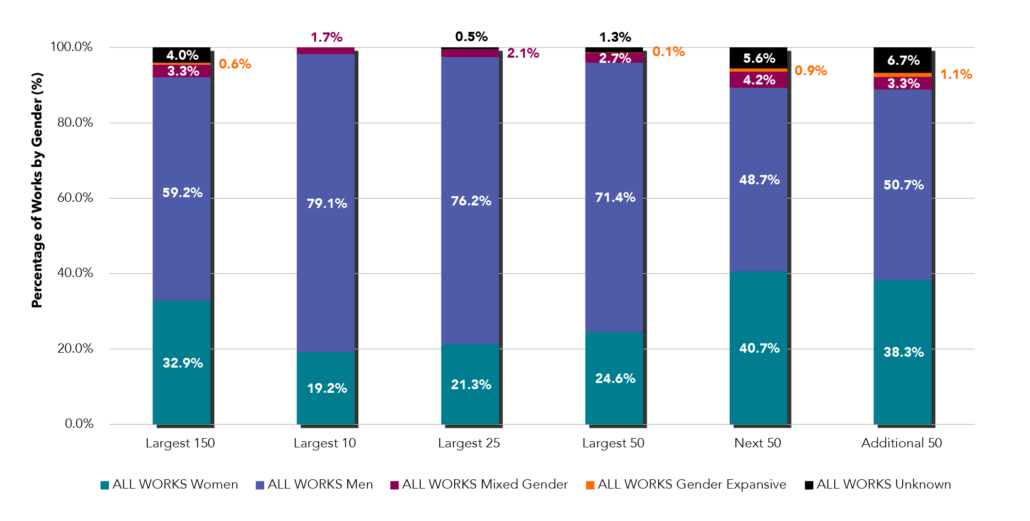
That progress matters because of where the money sits: the Largest 10 alone account for 52.6% of the Largest 150’s total FY 2023 expenditures. However, the Largest 10 still program the fewest works by women of any tier. Figure 1 shows that the Next 50 and Additional 50, companies with a fraction of the resources, continue to lead the field in terms of gender equity, programming 40.7% and 38.3% works by women, respectively. The gap shows in programming as well. Women choreographed 35.0% of mixed-bill works but, per Figure 2, only 25.7% of full- evening productions, which deliver the greatest prestige and require far more resources.
Figure 2: Full-Length Works – Choreographer Gender

Across the Largest 150, women choreographed 48.1% of the season’s 549 world premieres, a higher share than the 47.2% choreographed by men. Of the 439 unique choreographers who premiered new work, 48.5% were women. Women’s share of full-length world premieres — the prestigious, resource-intensive commissions most likely to enter standing repertoire — reached 34.4%, and has now risen every year since DDP began analyzing the Largest 150 in 2021-2022, when it stood at just 22.0%. The Largest 10 presented four full-length world premieres (two by women, two by men), which doubled the prior season’s count of two (one by a woman, one by a man).
Among non-premiere works, women choreographed 23.7% across the Largest 150 and just 17.1% within the Largest 50.
Works by women were also performed less often. On average, works by women had 3.5 performances per work versus 4.3 for works by men, a gap that holds in every tier except the Additional 50. Notably, this trend persists even when Balanchine’s widely programmed catalogue is excluded. Companies are commissioning women at parity, but the data raises the question of whether those works enter standing repertoires at the same rate – a key question DDP would like to investigate. George Balanchine was once again the most programmed choreographer; his 42 distinct works appeared 102 times across the season’s programming, staged by 37 companies and accounting for 6.3% of all 1,626 works. Excluding his appearances, women’s share of all works rises from 32.9% to 35.1%.
The most programmed woman for the 2024-2025 main season was Amy Hall Garner (seventh overall) with 11 programs across six companies. The most programmed living male choreographer, Christopher Wheeldon (fourth overall), was commissioned across 16 programs from 11 companies. Key Finding: Ten of the eleven most programmed choreographers for the 2024-2025 season were men, including Balanchine. Three women, Annabelle Lopez Ochoa, Jennifer Archibald, and Elisa Monte, tie at twelfth overall with eight programs apiece.
The Season Overview’s methodology has been substantially refined since 2019. This is DDP’s fourth edition assessing the full Largest 150 with tiered analysis that demonstrates how resources shape programming. It is the second year DDP has tracked the number of performances of each work. The report now distinguishes premiere status, venue type, and four gender categories (women, men, gender- expansive artists, and mixed-gender teams with “unknown attribution” reported separately). All data has undergone a four-pass verification process by the research team, drawing from company websites, archived pages, playbills, and press coverage.
Consistent with DDP’s methodology, this report covers each company’s main season in its home city; Tour dates are recorded separately but are not included in this report. Future analysis will examine which works and choreographers companies take on the road, and whose art is given the widest audience.
The full report, including year-over-year comparisons, a complete choreographer listing, and a list of the Largest 50 companies that programmed women-choreographed full-length works, is available here.


 People's Summit, Photo by Midia Ninja