DATA BYTE:
DATA BYTE: Season Announcements 2026‑2027
October 16th, 2026
October 20th: 2026 Dance Film Commission, October 20th: SPLIT BILL Series, October 22nd: Perform Europe Open Call, October 30th: Kennesaw State University Choreographic Residency, November 1st: Howard Fellowship, November 5th: CHOP SHOP: Bodies of Work, December 1st: Culture Forward Grant - The Svane Family Foundation Deadline 3, December 1st: Harkness Foundation for Dance Program/Project Grant, December 2nd: NYS Choreographers Initiative (NYSCI), December 31st: National Dance Project Presentation Grants - New England Foundation for the Arts, December 31st: National Dance Project Travel Fund, December 31st: New England Presenter Travel Fund, December 31st: Kit Modus In-person Choreographic Residency
×
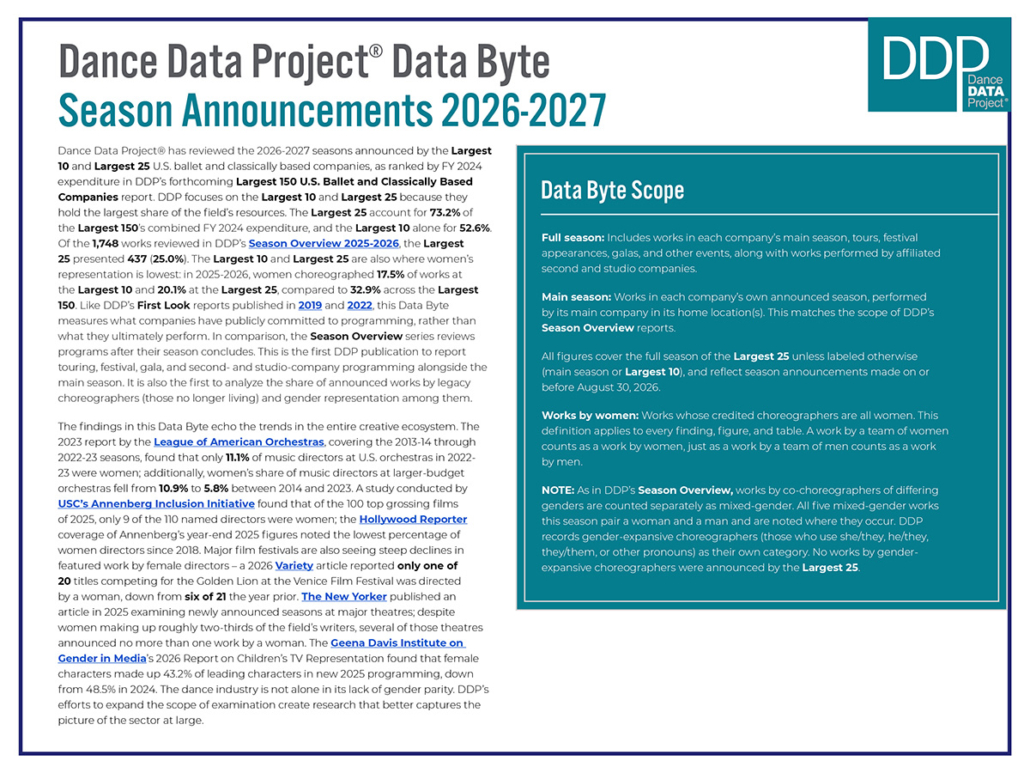
This report examines the gender distribution of works announced by the Largest 25 U.S. ballet and classically based companies for their upcoming season. This study marks a major expansion of DDP’s research scope. The inclusion of festival, gala, tour, studio, and second-company programming paints a more holistic picture of the industry, illuminating additional areas where choreography by women is underrepresented. It is also DDP’s first study to weigh women’s share by number of performances and to analyze legacy repertory.
In the Largest 25, women’s share of announced main season works, those performed by the main company at their home location(s), is 15.6% in 2026-2027, against 20.1% last season. This is the lowest share in the eight seasons DDP has tracked for the Largest 25. Women’s share of main-season full-length and mixed-bill works is also at or below its eight-season low. Main season all-female programs at the Largest 25 fell to 2.7% (4 of 147), down 3.0 percentage points from 5.7% last season and the lowest share in the eight seasons DDP has tracked. A note: this season is measured at announcement and may still change.
Research Lead Isaac Garcia says, “Our Season Overview has previously tracked who choreographs each season. This study widens the lens another step, on two fronts: what we collect and how we analyze it. We now look beyond the choreographer to the composers, arrangers, and stagers behind each work, across the full season, rather than the main season alone. Additionally we weigh each work by its number of performances. The more completely we capture how work reaches the stage, the clearer it is where women are being left out.”
DDP’s review of announced tour bills reveals even lower rates of choreography by women: 11.3% counted by works, 9.1% counted by performances. This is important because touring enables a company’s repertory to travel beyond its home city and the choreographer’s work to be showcased in new markets. Of the two largest season types, touring is where women’s work is least present.
Of the 458 works announced by the Largest 25, 146 (31.9%) are credited to a legacy choreographer (those no longer living) and only 7.5% of that repertory is by women. Women’s share of all other (non-legacy) works is 19.9%. In the main season, the split is starker: of the 302 announced main season works from the Largest 25, 104 (34.4%) are by legacy choreographers, and only 2.9% of that repertory is by women, compared with 22.2% of all other main season works. George Balanchine alone accounts for more main season works (53) than all main season works by women combined (47).
Works by women are concentrated at a few companies. Seven companies account for 29 (61.7%) of the 47 main season works by women announced by the Largest 25, and they contribute 46.7% of all main season works. Main season company shares of works by women range from 0.0% to 40.0%, and 14 of the Largest 25 announced no more than one main season work by a woman. The overall main season share of 15.6% does not describe a typical company. A handful of companies program most of the works by women, while most announced one or none.
There is one bright spot in the research. 36.7% of announced main season world premieres by the Largest 25 and 46.2% from the Largest 10 are by women. At the Largest 25, women’s share of main season world premieres is 1.9 percentage points higher than last season, though still below the rate from two seasons ago (46.3%). Women are still commissioned to create new work at a far higher rate than their work is programmed from standing repertory. Women choreographed 11.6% of main season works that companies have programmed before, and 9.4% of repertory works (existing works, including those new to a company).
The findings of this Data Byte echo trends throughout the creative ecosystem. The dance industry is not alone in its lack of gender parity. DDP is focused on arts as an economic sector, expanding its scope of research to better represent the arts economy at large. Examples: the 2023 report by the League of American Orchestras, covering the 2013-14 through 2022-23 seasons, found that only 11.1% of music directors at U.S. orchestras in 2022-23 were women. Women’s share of music directors at larger-budget orchestras fell from 10.9% to 5.8% between 2014 and 2023. A study conducted by USC’s Annenberg Inclusion Initiative found that of the 1,560 professional film contributors assessed, 8.2% of directors, 16.0% of writers, and 24.4% of producers were women; the Hollywood Reporter coverage of Annenberg’s year-end 2025 figures noted the lowest percentage of women directors since 2018. Major film festivals are also seeing steep declines in featured work by female directors. A 2026 Variety article reported only one of 20 titles competing for the Golden Lion at the Venice Film Festival was directed by a woman, down from six of 21 the year prior. The New Yorker published an article in 2025 examining newly announced seasons at major theatres, noting that despite women making up roughly two-thirds of the field’s writers, several of those theatres announced seasons with no more than one work by a woman.
Elizabeth ‘Liza’ Yntema, President and Founder of Dance Data Project® states, “The education of the dance sector we at DDP have driven over the last seven and a half years has revolutionized dance.” She continues, “To push the industry further to systemize a more equitable hiring process, DDP has created a fun to use ‘tool for change.’ DDP PRO puts a viable resource into the hands of company directors, those operating venues, or organizing festivals to look in your own backyard for an array of experienced performing arts industry members.” DDP Pro is an easy-to-use interactive map that identifies and platforms women in over 40 professions by zip code, creating recognition and opportunities on a community based level.
“Female choreographers and other brilliant arts professionals are everywhere,” says DDP External Communications Lead, Nancy Dobbs Owen, “Women are creating work in communities throughout the US. The pipeline and talent are there, all around us, representing a diverse, interesting population of highly skilled creatives hungry to create a more economically viable ecosystem. Use this tool. There are no excuses.”